Aconcagua: A First True High-Altitude Expedition
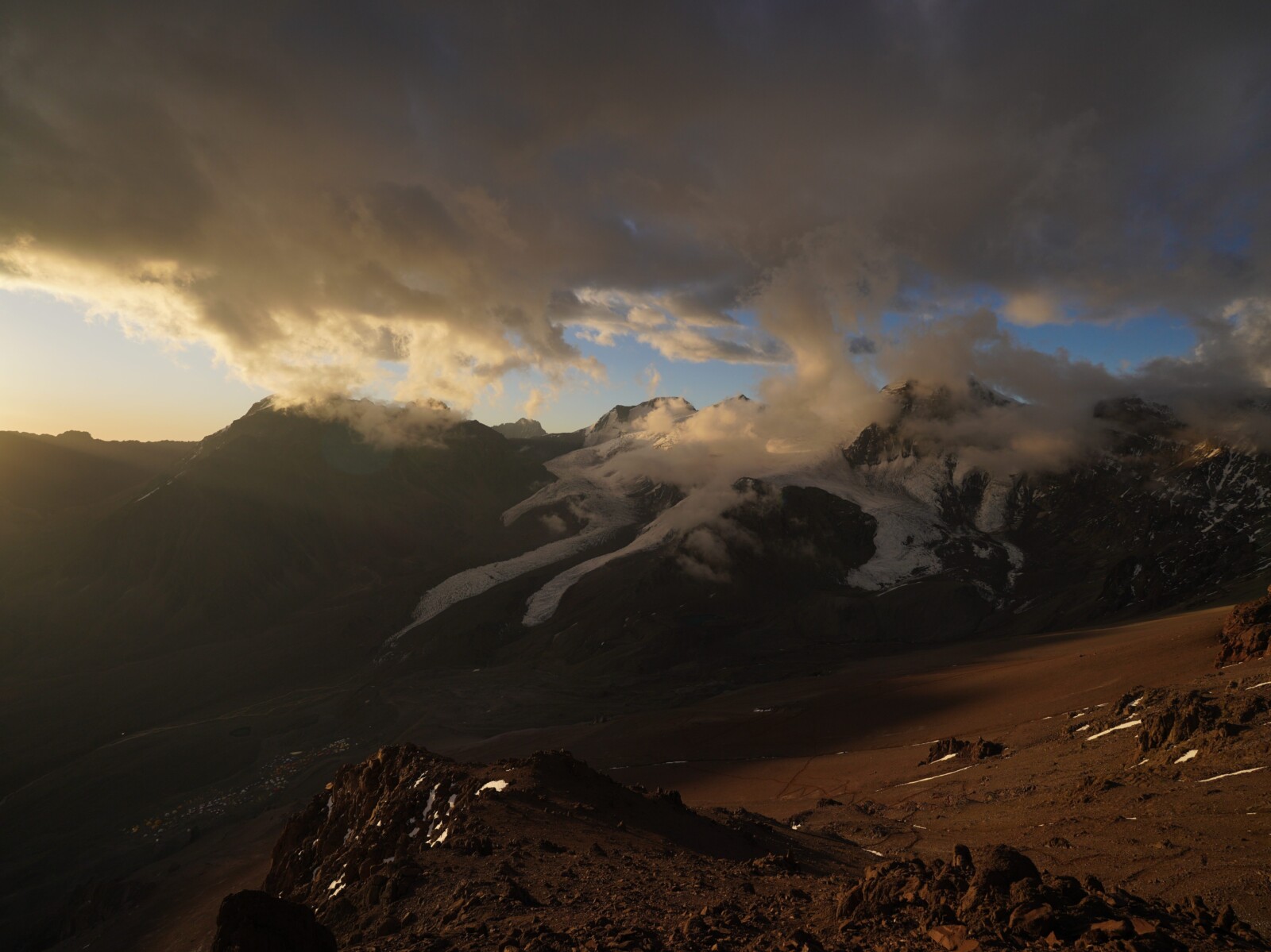
At 22,841 ft / 6,962 m, Aconcagua is the highest mountain in South America, the highest mountain outside Asia, and one of the Seven Summits.
The Normal Route is non-technical in favorable conditions, but Aconcagua is a serious high-altitude expedition. Altitude, wind, cold, long days, and carrying loads between camps make preparation, acclimatization, and good mountain judgment essential.
For many climbers, Aconcagua is the bridge between trekking at altitude and the bigger expedition mountains of Alaska and the Himalaya.
The BBE Approach
Our 19-day program begins before we enter Aconcagua Provincial Park.
We spend several days pre-acclimatizing in Las Cuevas, near the Chilean border, sleeping above 10,000 ft / 3,000 m and climbing progressively higher before beginning the expedition itself.
Once on Aconcagua, our scheduled departures are limited to six climbers, with a 3:1 client-to-guide ratio.
Our guides watch how the team is acclimatizing, recovering, moving, and responding to conditions. The itinerary allows flexibility for weather, route conditions, acclimatization, and the strength and health of the team.
Is Aconcagua Your Next Mountain?
You don’t need to arrive as an expert mountaineer, but you do need to arrive prepared.
Aconcagua can be an excellent first major high-altitude expedition and an important step for climbers with ambitions on bigger mountains.
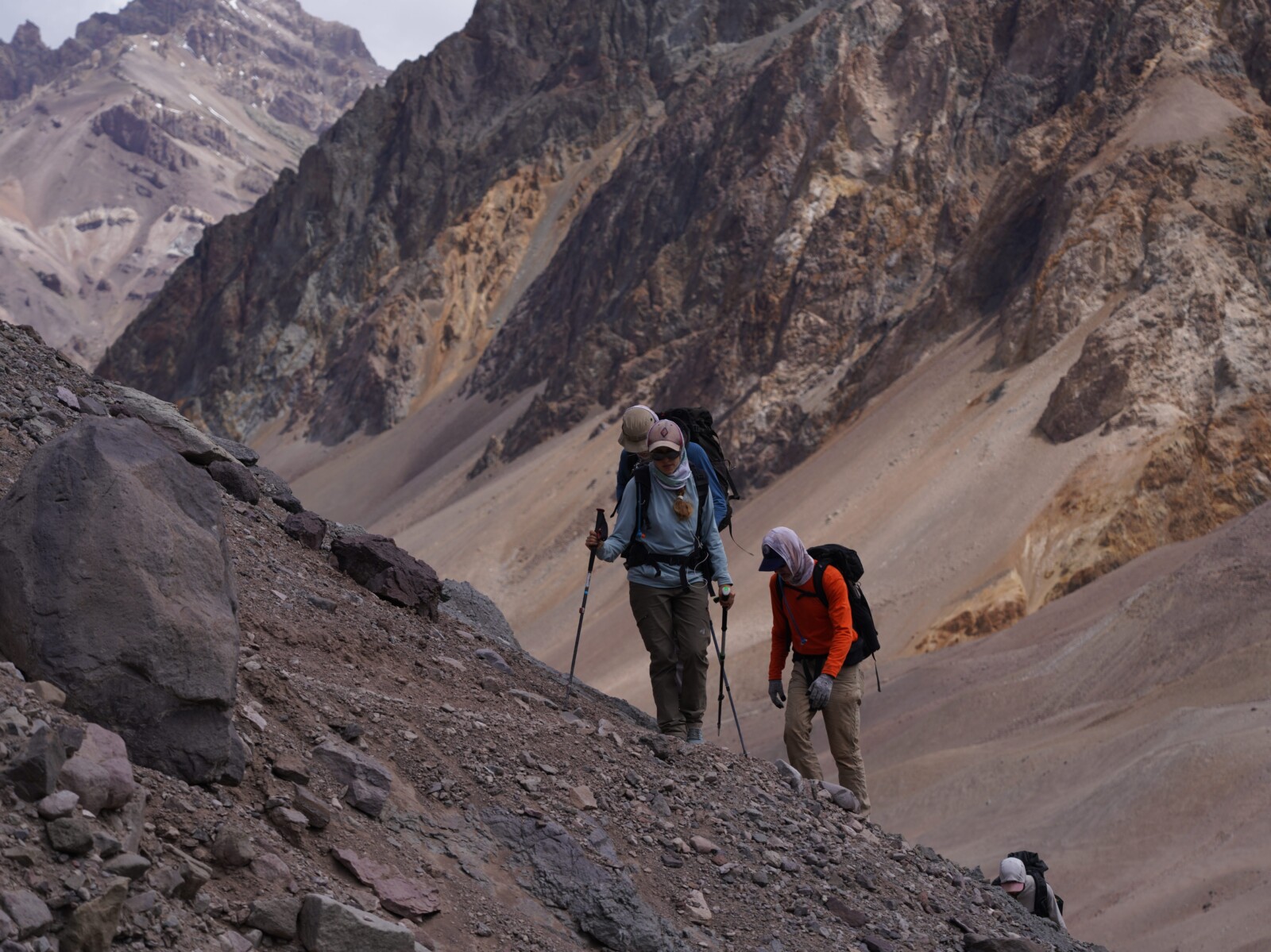
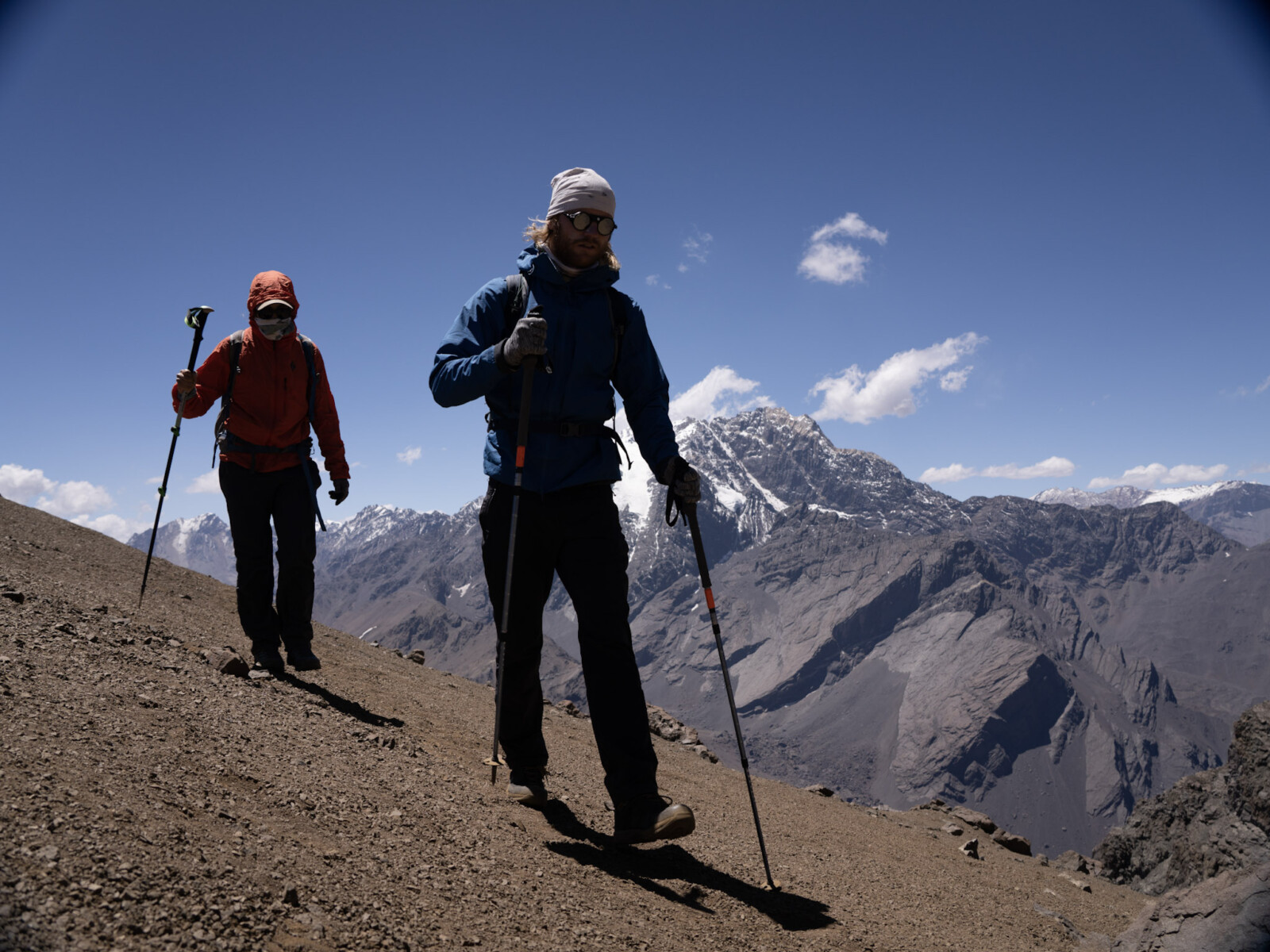
You should be prepared for consecutive mountain days, carrying a loaded pack, camping at altitude, cold and wind, and a long summit day above 22,000 feet.
If you’re unsure whether Aconcagua is the right next step, talk with us. Part of our job is helping you understand whether you’re ready—and, if you’re not quite there yet, what experience or preparation will help get you there.
The Normal Route
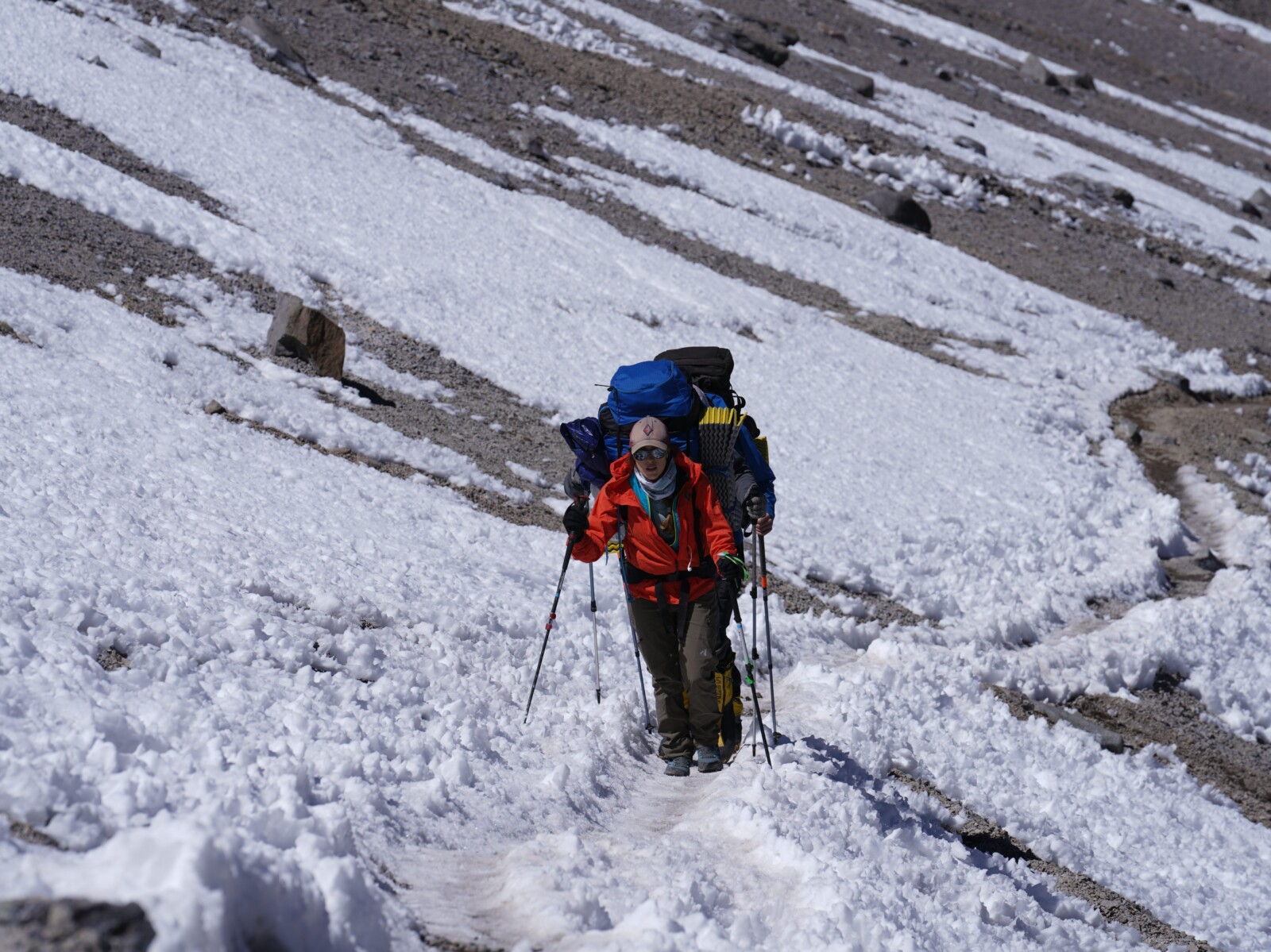
Aconcagua’s Normal Route follows the mountain’s Northwest Ridge from the Horcones Valley. In favorable conditions it does not involve technical climbing, but reaching 22,841 ft / 6,962 m requires sustained effort at extreme altitude, the ability to carry loads between camps, and enough flexibility to work around the mountain’s notoriously strong winds and changing weather.
Our 19-day itinerary is designed around those realities rather than around a rigid calendar.
Las Cuevas: Acclimatization Before the Mountain
After meeting in Mendoza, we travel into the Central Andes to Las Cuevas, near the Chilean border.
Here we begin acclimatizing before entering Aconcagua Provincial Park. We sleep at approximately 10,500 ft / 3,200 m and make progressively higher climbs, including days reaching approximately 13,800–14,500 ft / 4,200–4,400 m.
This first phase gives us several days to observe how each climber is responding to altitude while beginning the expedition as a team.
Horcones to Plaza de Mulas
Once the Las Cuevas phase is complete, we transfer to the Horcones entrance of Aconcagua Provincial Park and begin the approach through the Horcones Valley.
We first reach Confluencia at approximately 11,200 ft / 3,400 m, followed by the longer approach to Plaza de Mulas Base Camp at approximately 14,300 ft / 4,350 m.
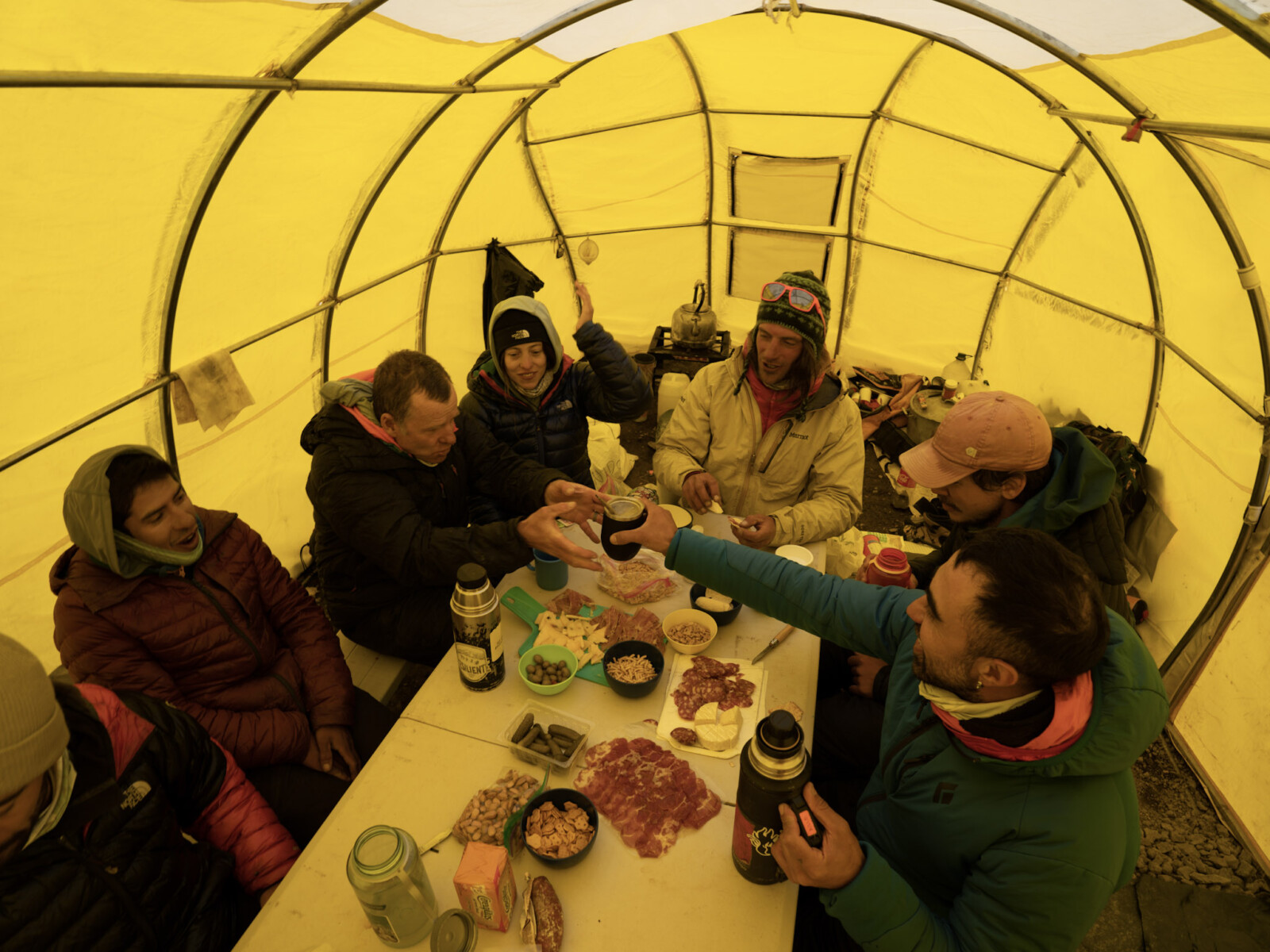
Mules transport expedition equipment to Base Camp. At Plaza de Mulas, we have a staffed base camp, sleeping tents, a mess tent, and prepared meals before beginning the move onto the upper mountain.
Moving Up the Mountain
Above Base Camp, the expedition changes.
We use a climb-high, sleep-low strategy, carrying and caching equipment before progressively establishing our higher camps.
Our planned camps are:
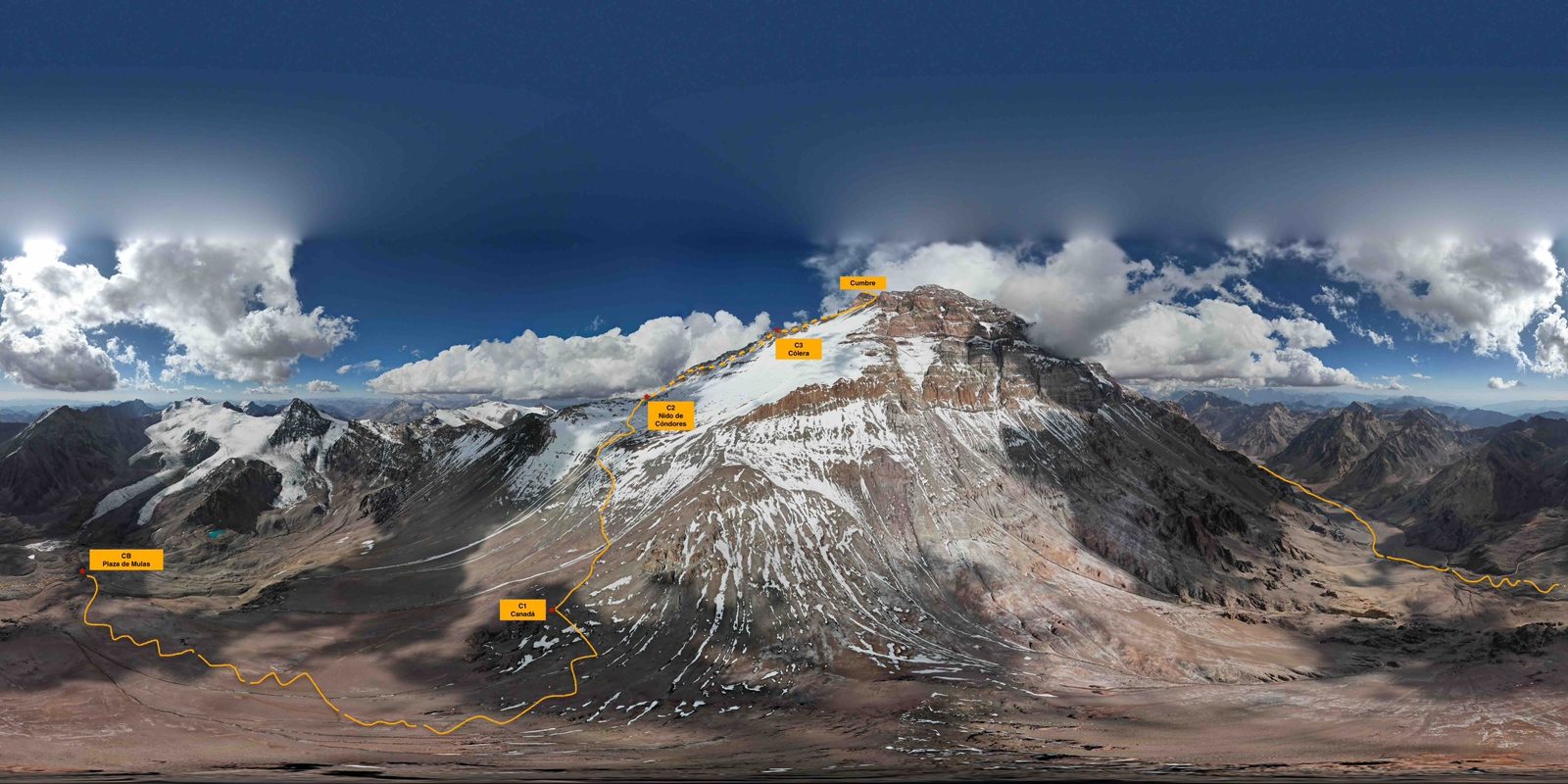
- Camp I — Plaza Don Fernando: approximately 16,200 ft / 4,938 m
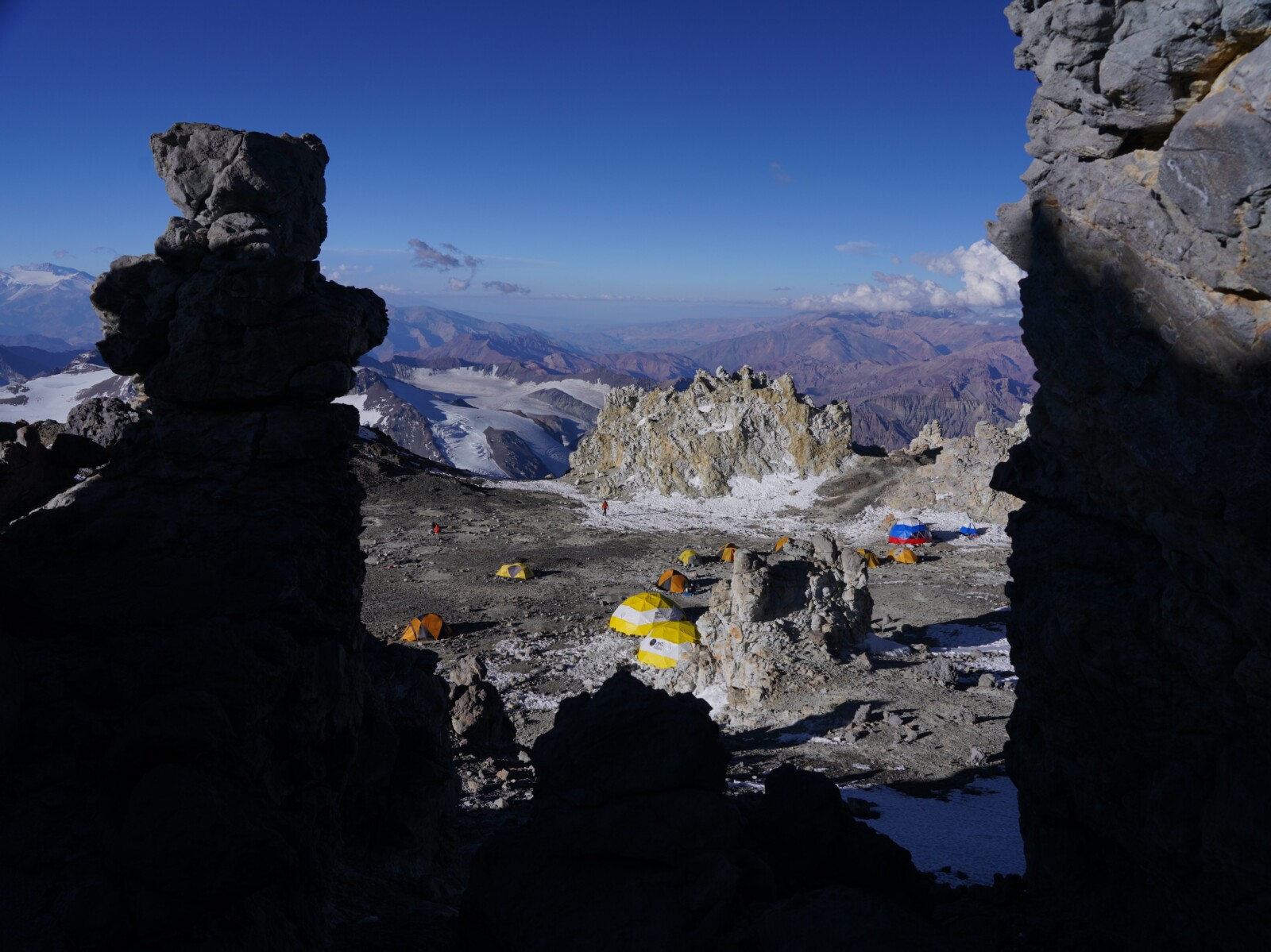
- Camp II — Plaza Don Benegas: approximately 18,400 ft / 5,608 m
- High Camp — Plaza Caluba: approximately 19,600 ft / 5,974 m
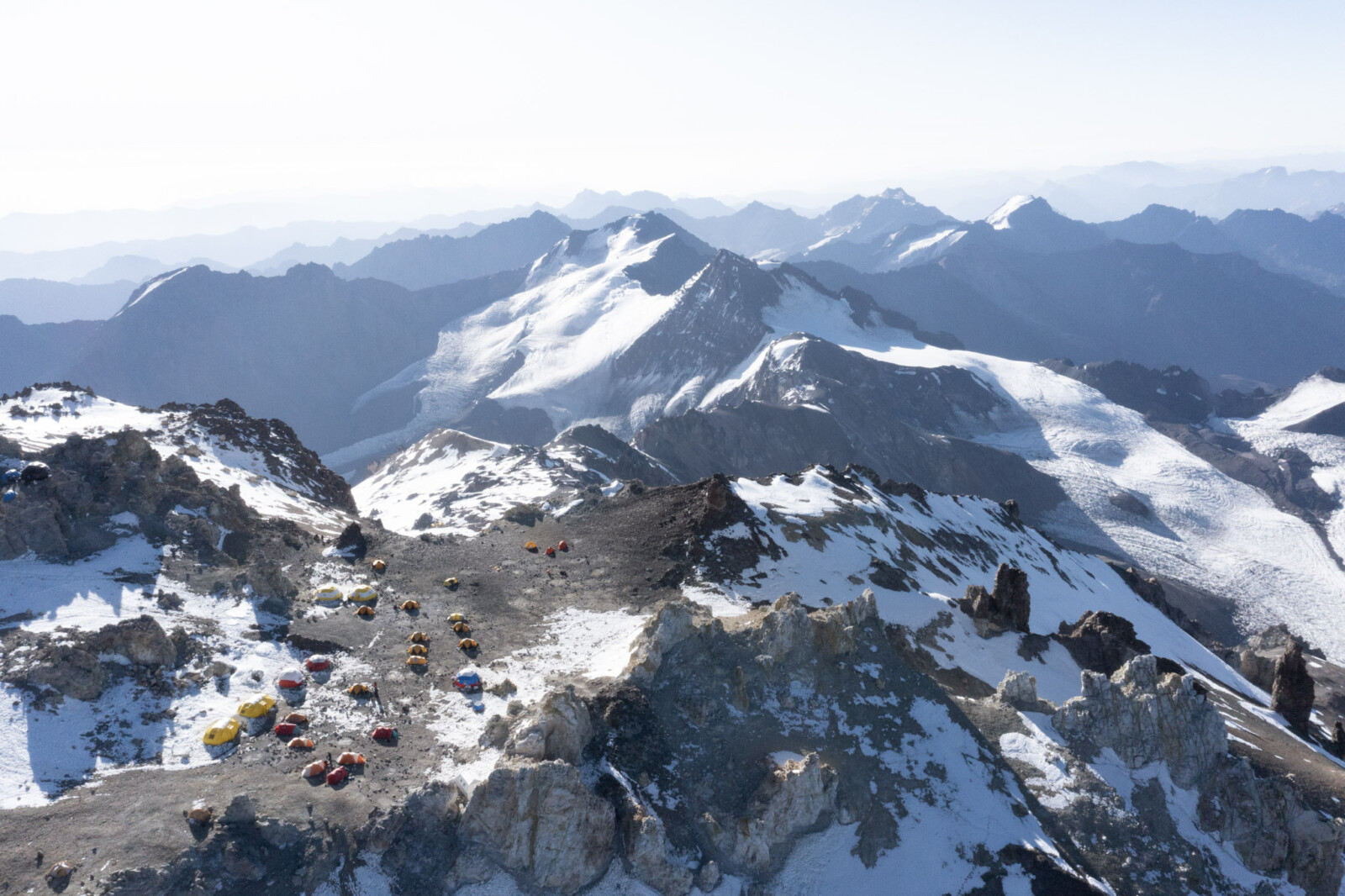
Plaza Caluba is BBE’s own high-camp location near Plaza Cólera, set slightly higher and apart from the main camp.
The exact progression is deliberately flexible. Weather, route conditions, acclimatization, and how the team is performing determine when we carry, when we move, when we rest, and when we position for a summit attempt.
Summit Day and the Canaleta
From Plaza Caluba, the route crosses the Cresta del Viento and traverses the upper Gran Acarreo toward the Canaleta.
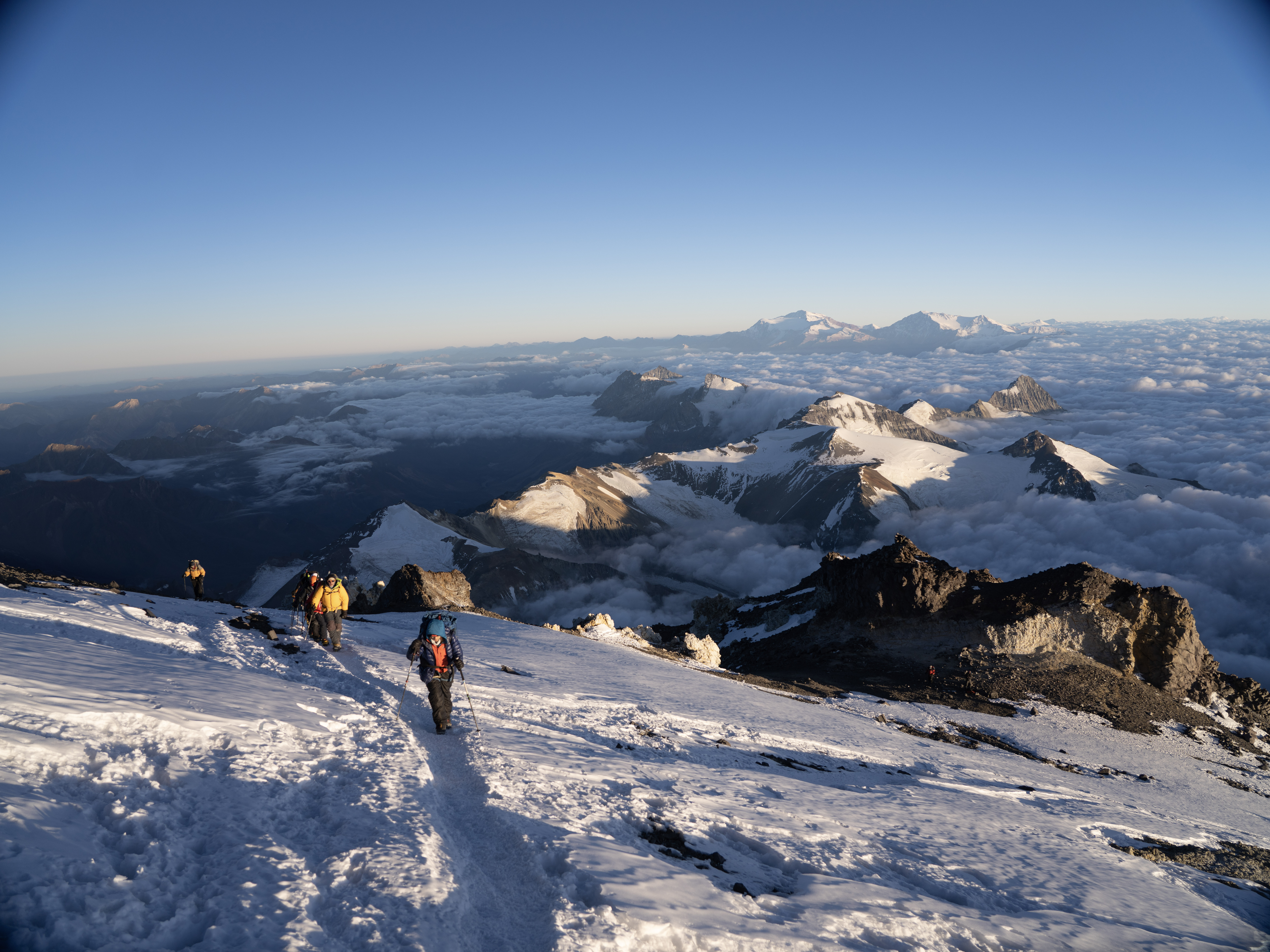
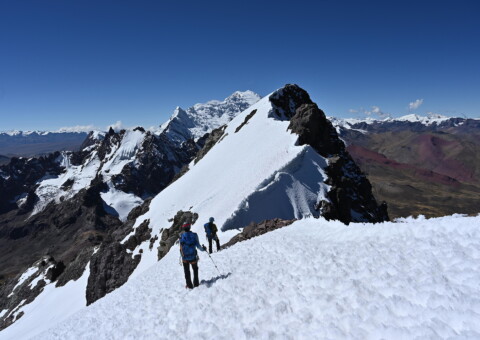
The Canaleta is one of the defining sections of Aconcagua’s Normal Route: approximately 1,300 ft / 396 m of steep scree at extreme altitude. Depending on conditions, crampons may be required. Progress here can be slow, and patience and stamina matter as much as speed.
Above the Canaleta, we reach the Cresta del Guanaco, which leads toward Aconcagua’s true summit at 22,841 ft / 6,962 m.
A summit attempt and return to Plaza Caluba can require approximately 9–14 hours of continuous movement, depending on conditions and the team.

How We Climb
Aconcagua is not climbed according to a stopwatch.
Strong winds and storms can arrive from the Pacific, and altitude affects every climber differently. For that reason, our itinerary includes flexibility for weather, acclimatization, and recovery.
Above Base Camp, local high-altitude porters assist with group equipment such as tents, stoves, fuel, and food. Personal porter support can also be arranged for climbers who want to reduce the loads they carry.
Throughout the expedition, the guides are evaluating more than whether someone can simply keep walking. We watch acclimatization, recovery, pace, hydration, weather, route conditions, and how the team is functioning together.
The itinerary gives us the framework. The mountain and the people climbing it determine the decisions.
19 Days · Mendoza → Las Cuevas → Horcones → Plaza de Mulas → Northwest Ridge → Summit → Mendoza
Over 19 days, the expedition changes gradually — city, mountain lodge, tents. Roads become trails, and life is reduced to the essentials: steady movement, warm clothing, food, water, recovery, and good decisions.
The itinerary is carefully designed but not rigid. Weather, wind, health, park medical controls, and the condition of the team may change the plan. That flexibility is part of climbing a mountain this high responsibly.
All distances, elevations, and times below are approximate.
Elevation: Approximately 750 m / 2,460 ft
Activity: Arrival, orientation and equipment review
Overnight: Mendoza hotel · welcome dinner included
A member of the BBE team meets you at the airport. The team gathers, reviews the route and acclimatization plan, and your guide checks the equipment that will matter once you are far from Mendoza — the time to fix small problems before they become serious ones higher up.
BBE completes the climbing-permit process (the fee is paid separately, per the instructions sent before arrival), and the team shares a welcome dinner. The expedition has started.
Sleeping altitude: Las Cuevas — approximately 3,200 m / 10,500 ft
Driving: Approximately 190 km / 118 mi · 3–4 hours
Activity: Short acclimatization walk
Overnight: Mountain lodging in Las Cuevas
The road follows the Mendoza River west toward the Argentine–Chilean border — each hour the air cooler, the vegetation thinner, the peaks larger. In Las Cuevas you are already sleeping above 3,000 meters.
A short afternoon walk starts the BBE acclimatization process. Your guide begins watching pace, breathing, hydration and recovery. From here on, altitude is part of every decision.
Maximum altitude: Up to approximately 4,200 m / 13,780 ft
Hiking time: Approximately 5–7 hours · daypack
Overnight: Mountain lodging in Las Cuevas
You climb into the mountains surrounding Las Cuevas; the exact route depends on weather, snow and the team. The day is as much about observation as elevation — your guide watches how you pace, drink and recover, and you begin learning the steady rhythm that will carry you through the expedition.
There is no prize for reaching the high point first. Climb well, return with energy, let the body adapt.
Sleeping altitude: Approximately 3,900 m / 12,800 ft
Hiking time: Approximately 4–6 hours
Pack: Overnight equipment plus an assigned share of group gear — up to approximately 20 kg / 44 lb
Overnight: Mountain tents
You leave the lodge and begin living as an expedition team. At camp everyone has a role — tents secured, sleeping systems organized, water prepared.
It is your first night in a tent near 4,000 meters, and the habits you establish here follow you onto Aconcagua.
Maximum altitude: Approximately 4,300–4,420 m / 14,100–14,500 ft
Hiking time: Approximately 5–7 hours
Overnight: Mountain lodging in Las Cuevas
After breaking camp, the team continues toward a higher ridge or nearby summit — the high point depends on conditions and how everyone responded to the night. You climb high enough to create another acclimatization stimulus, then descend to Las Cuevas while the team is still moving well.
Tomorrow, you enter Aconcagua Provincial Park.
Camp altitude: Confluencia — approximately 3,414 m / 11,200 ft
Distance: Approximately 7.5 km / 4.7 mi · 3–4 hours
Pack: Daypack — mules carry designated approach loads
Medical control: First required park medical check
Overnight: Confluencia Camp
The road ends and the expedition begins on foot. From the park entrance at Horcones, the trail follows the valley toward Confluencia — with your first clear view of Aconcagua’s south face along the way.
At camp you complete the first required park medical check, while your BBE guide continues a separate assessment of how you are moving, eating and recovering.
Camp altitude: Plaza de Mulas — approximately 4,350 m / 14,300 ft
Distance: Approximately 17–19 km / 10.5–12 mi · 7–9 hours
Pack: Daypack — mules carry designated approach loads
Overnight: Plaza de Mulas Base Camp
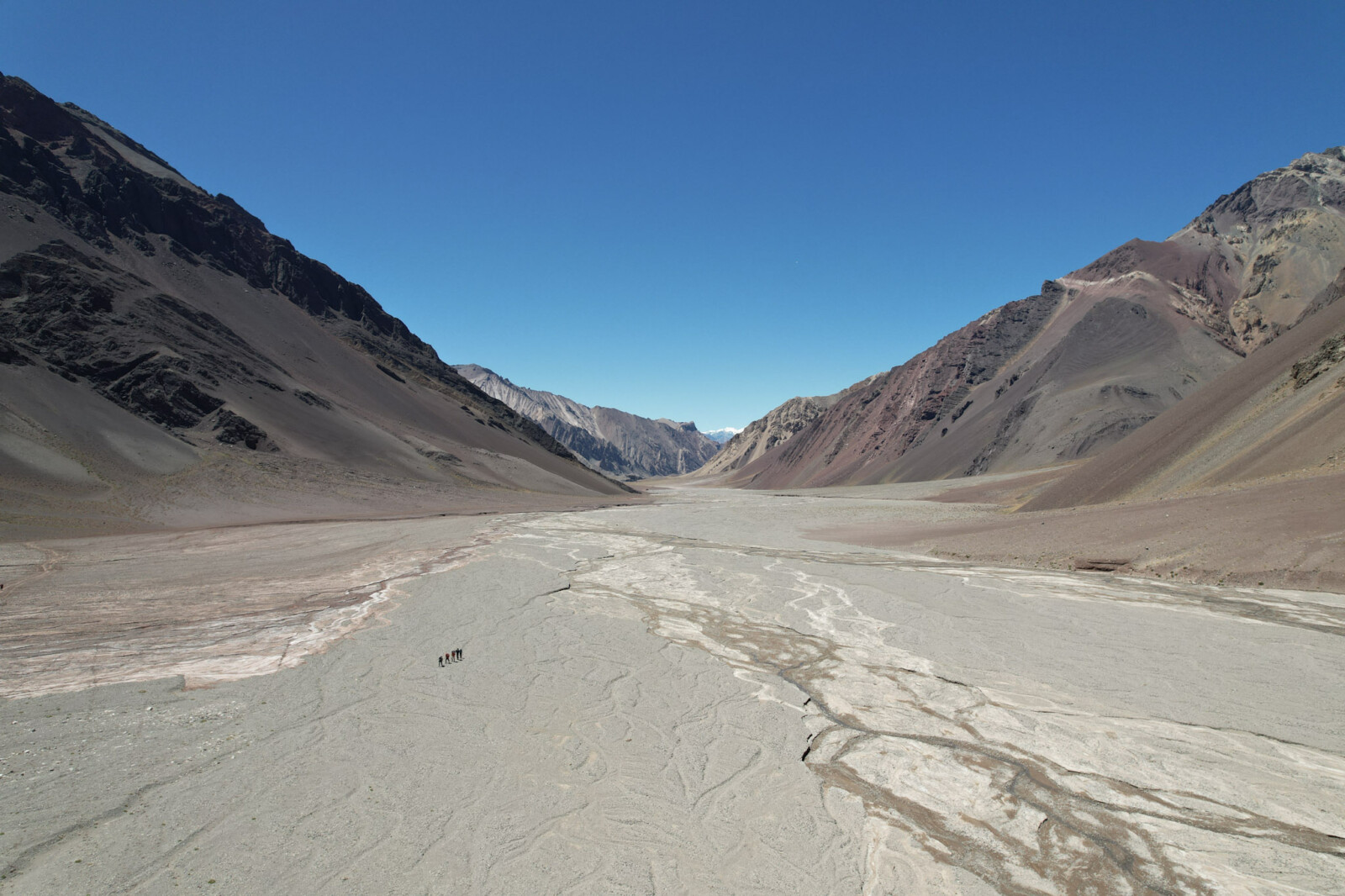
The longest day of the approach. You cross Playa Ancha, a wide, exposed plain where distance is hard to judge. The terrain is not technical, but distance, altitude, sun and wind make the day demanding — and the work done in Las Cuevas shows its value.
By late afternoon, the tents of Plaza de Mulas appear beneath Aconcagua’s west face. From here, every camp lies above you.
Altitude: Plaza de Mulas — approximately 4,350 m / 14,300 ft
Medical control: Second required park medical check
Overnight: Plaza de Mulas Base Camp
A recovery day, but not an empty one: eat, hydrate, dry clothing, absorb the approach. You complete the second park medical check — clearance is required, but your guide also weighs symptoms, appetite, sleep and recovery.
The team reduces the big duffels to true upper-mountain equipment. The next time you leave base camp, you are climbing the mountain itself.
Maximum altitude: Camp Canadá / Plaza Don Fernando — approximately 5,050 m / 16,570 ft
Hiking time: Approximately 5–7 hours · load up to approximately 20 kg / 44 lb
Sleep: Plaza de Mulas Base Camp
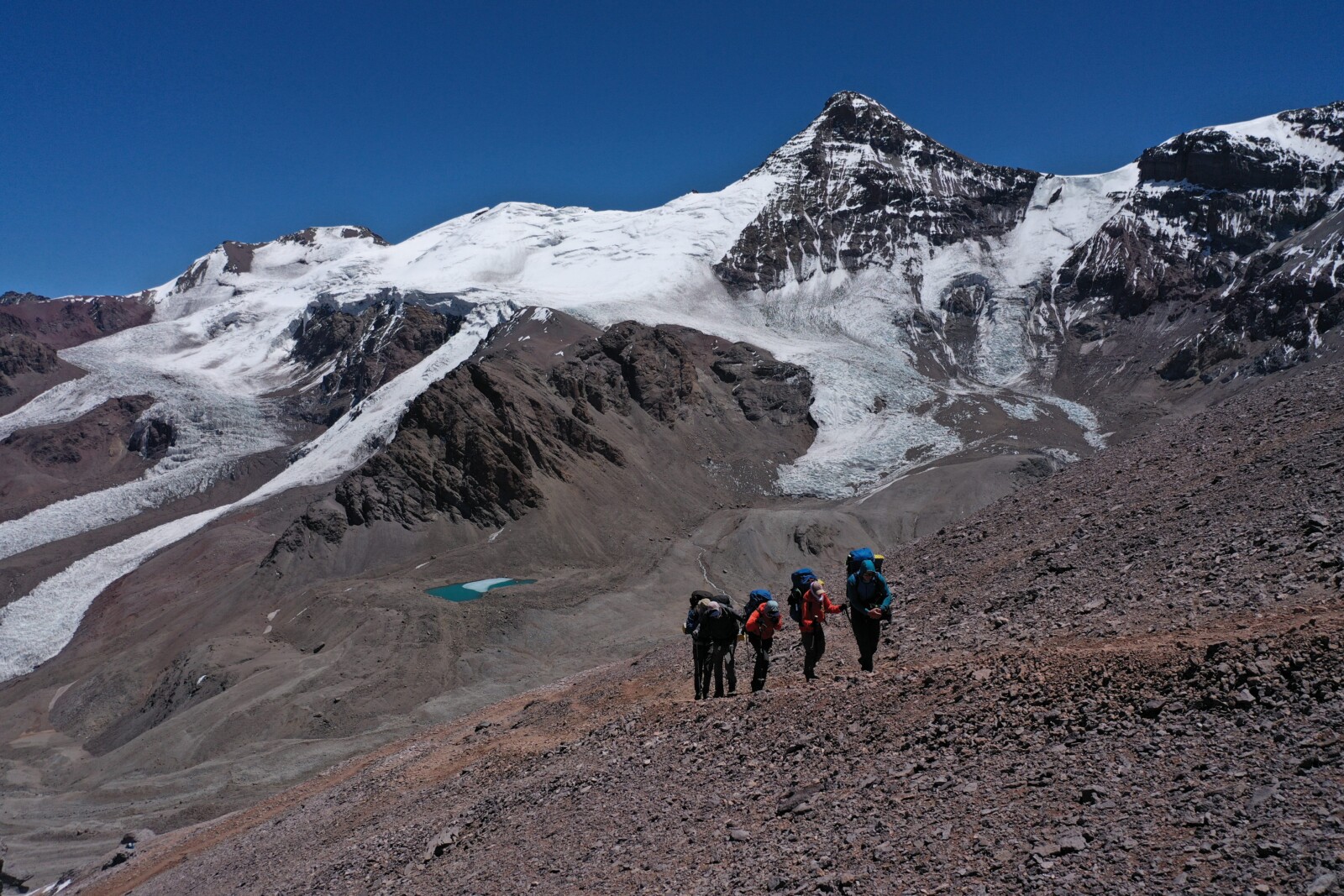
You step onto the upper mountain, carrying food, fuel and equipment up steep, loose terrain to establish a cache at Camp Canadá / Plaza Don Fernando, then return to sleep in thicker air.
Gaining 700 meters at this altitude takes patience — and gives your body another controlled exposure above 5,000 meters.
Sleeping altitude: Camp Canadá / Plaza Don Fernando — approximately 5,050 m / 16,570 ft
Hiking time: Approximately 3–5 hours · load up to approximately 20 kg / 44 lb
Overnight: Camp Canadá / Plaza Don Fernando
This time you do not turn back. Your guide sets a controlled pace, watching for small changes in breathing, coordination or energy.
At Camp Canadá / Plaza Don Fernando, the team builds its home on the mountain — tents anchored, water melted, an early, quiet evening. You are now living above 5,000 meters.
Maximum altitude: Nido de Cóndores / Plaza Benegas — approximately 5,550 m / 18,210 ft
Hiking time: Approximately 5–7 hours · load up to approximately 20 kg / 44 lb
Sleep: Camp Canadá / Plaza Don Fernando
You climb broad, open slopes toward Nido de Cóndores / Plaza Benegas, where wind is often a constant companion. Nido sits on a wide plateau — an endless horizon on a clear day, severe on a windy one.
You cache equipment and descend to sleep at Camp Canadá / Plaza Don Fernando. The system is making sense: climb, prepare, descend, eat, sleep, repeat.
Sleeping altitude: Nido de Cóndores / Plaza Benegas — approximately 5,550 m / 18,210 ft
Hiking time: Approximately 4–5 hours · load up to approximately 20 kg / 44 lb
Overnight: Nido de Cóndores / Plaza Benegas
You climb back to the cache with a heavier load — and this time you stay. At Nido de Cóndores / Plaza Benegas, the exposure is immediate: wind against the tents, every camp task slower.
The team focuses on fundamentals — water, food, warmth, rest — and communicates honestly about condition. The summit feels close, but it is still a long way above.
Sleeping altitude: Cólera / Plaza Caluba — approximately 6,000 m / 19,685 ft
Hiking time: Approximately 3–4 hours · load up to approximately 20 kg / 44 lb
Overnight: Cólera / Plaza Caluba
Short on a map, demanding in practice. At Cólera, BBE normally establishes high camp at Plaza Caluba, the name we use for our preferred campsite slightly above the main camping area. Damian began using this location years ago for better protection from the wind and more separation from the crowded standard Cólera camping area.
From here, the summit route finally becomes real — you can see the terrain toward Independencia and the traverse below the summit ridge.
Camp work is efficient: tent, clothing, water for the night and the summit attempt. Your guide reviews weather, departure time and turnaround expectations. The final decision to climb depends on health, wind, temperature and conditions.
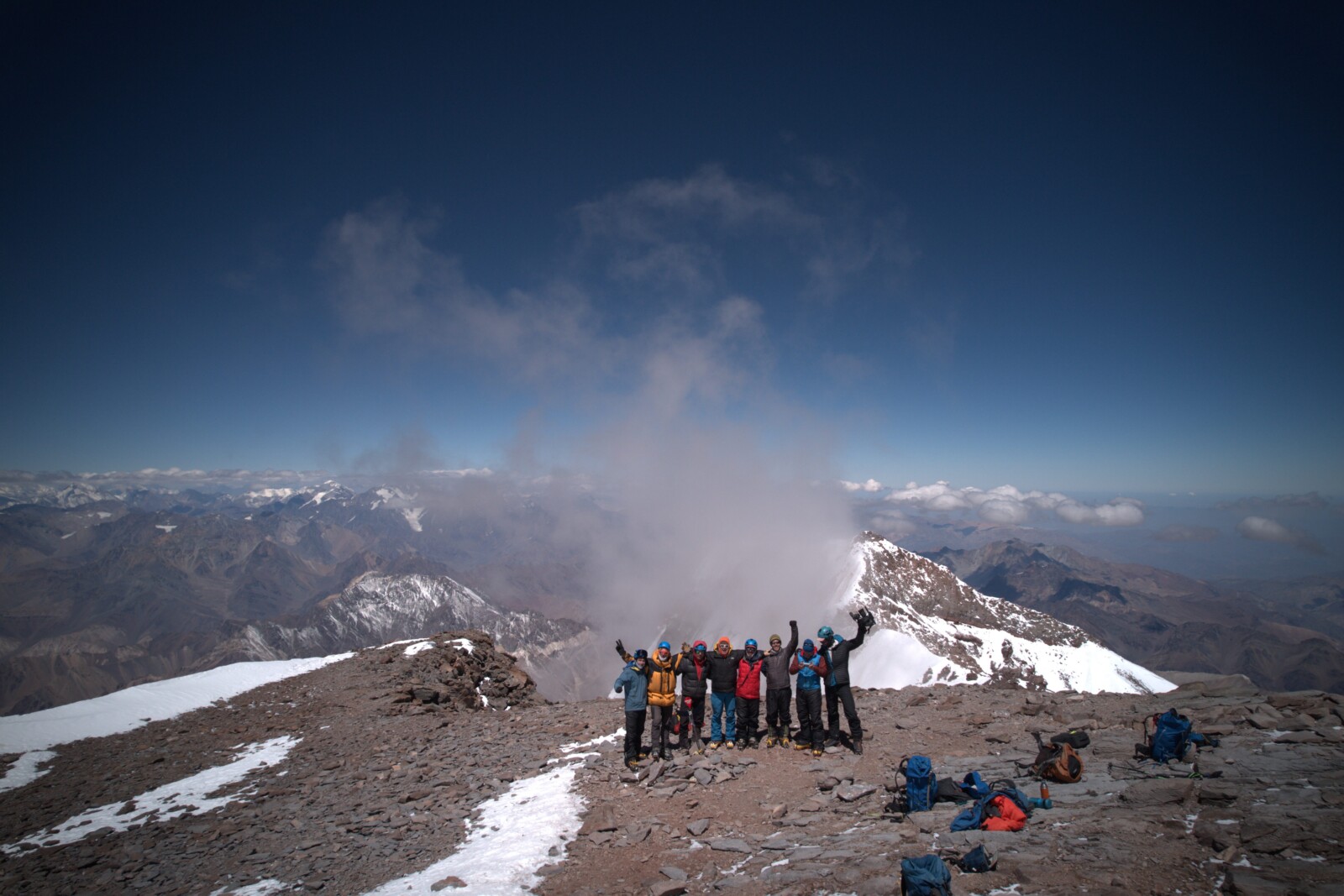
Maximum altitude: Aconcagua summit — 6,962 m / 22,841 ft
Sleeping altitude: Cólera / Plaza Caluba — approximately 5,974–6,000 m / 19,600–19,685 ft
Elevation gain/loss: Approximately 988 m / 3,241 ft up and down
Round-trip time: Approximately 10–13 hours · summit pack
Overnight: Cólera / Plaza Caluba, unless the guide changes the descent plan
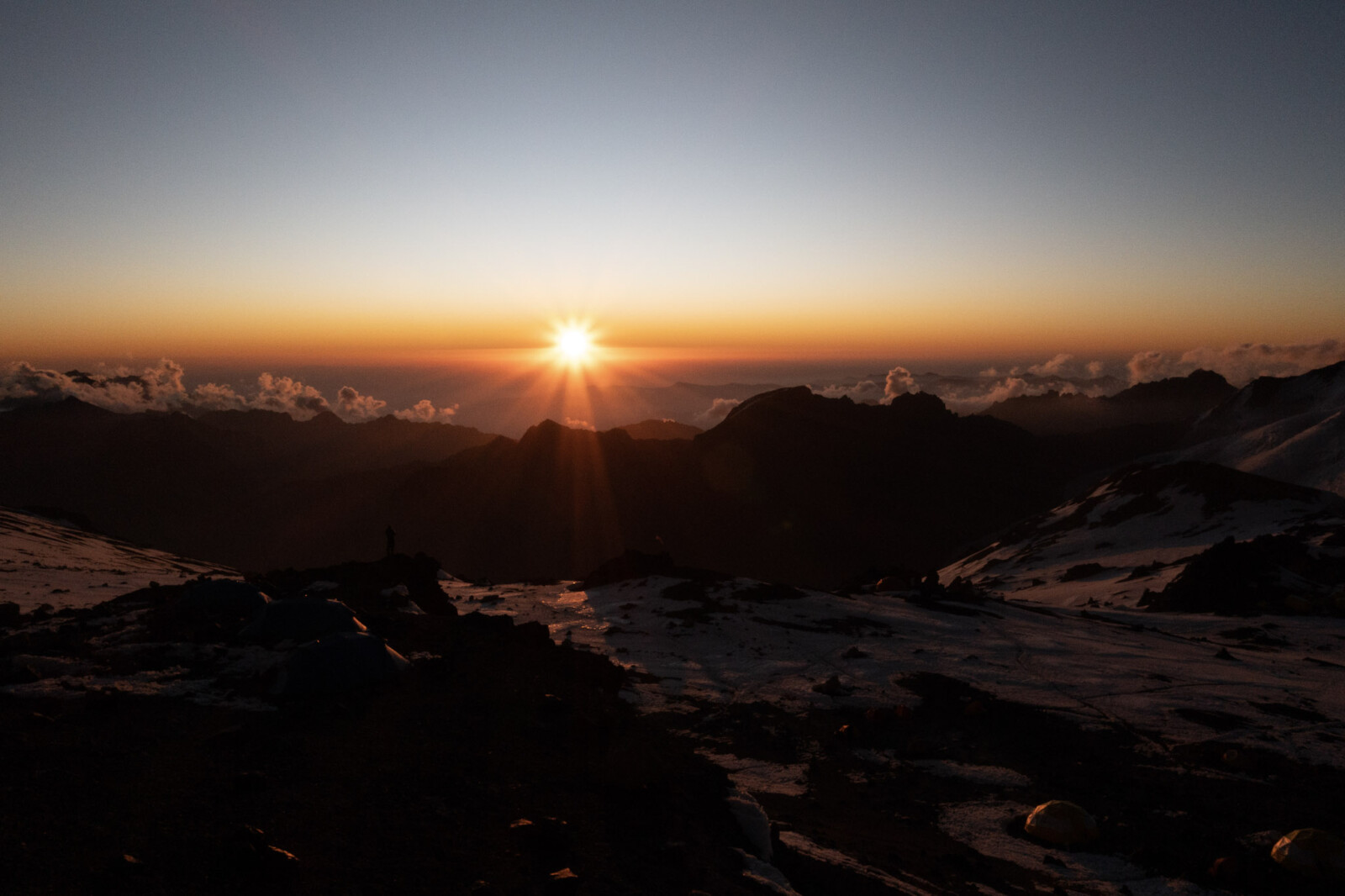
Summit day is the longest and most demanding day of the expedition. We wake in darkness and prepare at Plaza Caluba before leaving under headlamps. Departure time depends on wind, temperature, weather and the condition of the team.
From high camp, the route climbs gradually toward Independencia before crossing the Cresta del Viento — the Windy Crest. From here we traverse the upper section of the Gran Acarreo, where exposure to wind and cold can be significant.
The route eventually reaches the base of the Canaleta, one of the defining sections of Aconcagua’s Normal Route. The Canaleta gains approximately 300–400 vertical meters / roughly 1,000–1,300 ft through steep scree at extreme altitude. Progress here is slow and deliberate. Depending on conditions, crampons may be required, and the upper section can involve some scrambling.
At this altitude, gaining even 100 vertical meters can take close to an hour. Patience, pacing and the ability to keep moving steadily are more important than speed.
Above the Canaleta, we reach the Guanaco Ridge, which joins the lower South Summit area with Aconcagua’s higher North Summit. The route follows the ridge along the edge of the immense South Face toward the true summit.
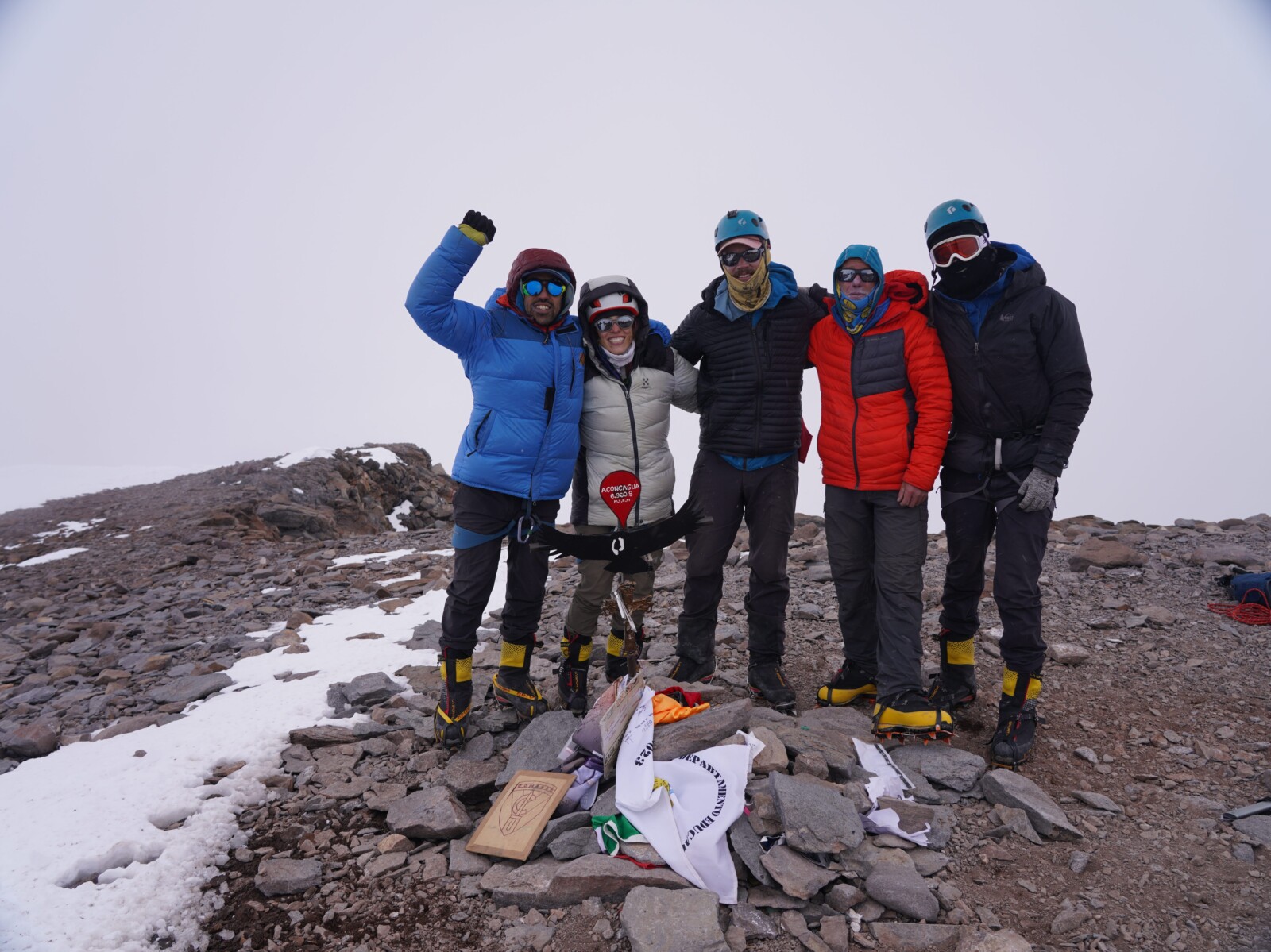
At 22,841 ft / 6,962 m, an aluminum cross marks the highest point in the Americas. On a clear day, the views extend across the Central Andes and can reach toward the Pacific.
Reaching the summit is only half the day.
From the top, we descend the same route through the Guanaco Ridge, Canaleta, Gran Acarreo and Independencia back toward Plaza Caluba. The descent demands concentration after many hours at altitude, and returning safely to high camp remains the priority.
A summit is never guaranteed. Your guide may turn an individual climber or the team around because of pace, symptoms, wind, weather, temperature, timing or changing conditions. That decision is part of responsible high-altitude climbing.
Activity: Reserved contingency days for weather, acclimatization, recovery, summit attempt or descent
Overnight: Determined by the guide team according to the expedition’s progress
These are not “days off.” They are intentionally built into the 19-day itinerary to give the expedition flexibility on Aconcagua.
Aconcagua is known for strong winds and rapidly changing mountain weather. A summit attempt cannot be safely tied to one predetermined calendar day. The team also needs to be sufficiently acclimatized, healthy and recovered before moving higher or attempting the summit.
If conditions are favorable, we may attempt the summit on Day 14 and use these days to begin our descent and recovery.
If Day 14 is not suitable for a summit attempt, one or both of these days may become additional summit opportunities. The team may wait at high camp, rest lower on the mountain, adjust the climbing schedule, or descend depending on conditions.
The decision is made by the guide team based on weather forecasts, wind, temperature, snow and route conditions, acclimatization, health, pace, recovery and the team’s ability to climb and descend safely.
Building these contingency days into the itinerary does not guarantee a summit. What they provide is something extremely valuable on a high-altitude mountain: options.
If the mountain gives us a safe opportunity, we want enough time in the schedule to use it. If conditions tell us to wait or descend, we want enough flexibility to make that decision without being forced by an unnecessarily tight itinerary.
Flexibility is not unused time. It is part of the expedition strategy.
Ending altitude: Plaza de Mulas — approximately 4,350 m / 14,300 ft
Hiking time: Approximately 5–7 hours
Overnight: Plaza de Mulas Base Camp
After the summit attempt and our time at high camp, we begin the long descent back to Plaza de Mulas.
We descend from Cólera / Plaza Caluba, passing Nido de Cóndores / Plaza Benegas and Camp Canadá / Plaza Don Fernando, collecting cached equipment as we move down the mountain.
The change is remarkable. With every few hundred meters of descent the air becomes thicker, movement becomes easier, and the landscape begins to feel different.
Eventually we arrive back at Plaza de Mulas Base Camp, where chairs, prepared food and room to spread out can feel remarkably luxurious after living high on the mountain.
Whether or not the summit was reached, the team has spent days living, climbing and making decisions at serious altitude. The expedition is not finished yet, but the upper mountain is now behind us.
Distance: Approximately 24 km / 15 mi · 7–9 hours trekking
Driving: Approximately 3–4 hours to Mendoza
Pack: Daypack — mules carry designated expedition loads
Overnight: Mendoza hotel
One substantial mountain day remains.
We leave Plaza de Mulas early and retrace the Horcones Valley, crossing Playa Ancha and continuing all the way to the park entrance at Horcones. It is a long descent — approximately 24 km / 15 miles — but after days at high altitude, every kilometer brings thicker air and warmer temperatures.
Mules carry the designated expedition loads while you trek with a daypack.
At Horcones, we leave the trail behind and meet our transportation for the drive back through the Central Andes to Mendoza.
The transition happens quickly. After nearly three weeks organized around altitude, weather, tents, water and the next day’s climb, you are suddenly back among trees, traffic, restaurants and warm evening air.
We check into our Mendoza hotel, where a shower, clean clothes and a real bed mark the end of the mountain portion of the expedition.
Activity: Breakfast, hotel checkout and independent airport transfer
Airport transfer: Not included — departure times vary; BBE can help you arrange one
After breakfast, the expedition officially comes to an end.
Airport transfers are not included because departure times vary, but BBE can help you arrange transportation to Mendoza Airport or assist with onward travel plans.
Some people leave Aconcagua with a summit. Others leave with hard-earned experience and a clearer understanding of themselves at altitude. Most carry some of both.
Is Aconcagua Right for You?
Aconcagua is often described as a non-technical mountain, but that should never be confused with an easy mountain.
The Normal Route does not normally require technical climbing, but for nearly three weeks you will walk long days, carry real loads, sleep progressively higher, and function in increasing cold with less and less oxygen.
For many climbers, Aconcagua will be one of the hardest things they have ever done.
This is the conversation we would have with you before booking — honest, specific and without sales pressure. Our goal is not simply to get you onto Aconcagua. It is to help determine whether Aconcagua is the right mountain for you now.
What Makes Aconcagua Hard
Not the technical climbing. The living at altitude.
The difficulty comes from:
- Altitude — you will sleep above 5,000 m / 16,400 ft for multiple nights and spend summit day approaching 7,000 m / 23,000 ft, where every step requires deliberate effort.
- Cold and wind — temperatures can fall far below freezing on the upper mountain, with severe wind chill.
- Long days — expect 7–9 hours on the biggest approach day and approximately 10–13 hours round-trip on summit day.
- Load carrying — on upper-mountain days, prepare to carry loads of up to approximately 20 kg / 44 lb.
- Recovery — you need to wake up and perform again after consecutive days of effort.
- Patience — weather holds are part of expedition climbing. You may spend time waiting for a safe opportunity to move or attempt the summit.
The Fitness Required
Excellent cardiovascular endurance is essential. This is one of the most important factors you can control before arriving in Argentina.
You should be able to hike for 7–9 hours with a loaded pack and get up the following morning capable of doing it again. This needs to be repeated over multiple days.
You should be comfortable carrying approximately 20 kg / 44 lb on steep, loose mountain terrain and arrive with a reserve of fitness rather than arriving at your limit. Altitude will take away some of the performance you have at home.
Most climbers should plan on four to six months of serious preparation, including long weighted-pack hill days, back-to-back training days and consistent aerobic conditioning.
If you contact us early, we can help assess where you are and what your preparation should focus on.
The Experience Required
The Normal Route requires no technical climbing and normally no roped climbing.
What matters more is mountain experience: multi-day trips, sleeping in tents, managing your clothing and equipment, eating and hydrating when you may not feel like it, and continuing to function through changing weather and increasing fatigue.
Previous altitude experience is extremely valuable. A trek or climb above approximately 4,000–5,000 m / 13,000–16,400 ft — such as Kilimanjaro, a high Andean trek or a comparable objective — gives you experience that training at home cannot provide: an understanding of how your own body responds to altitude.
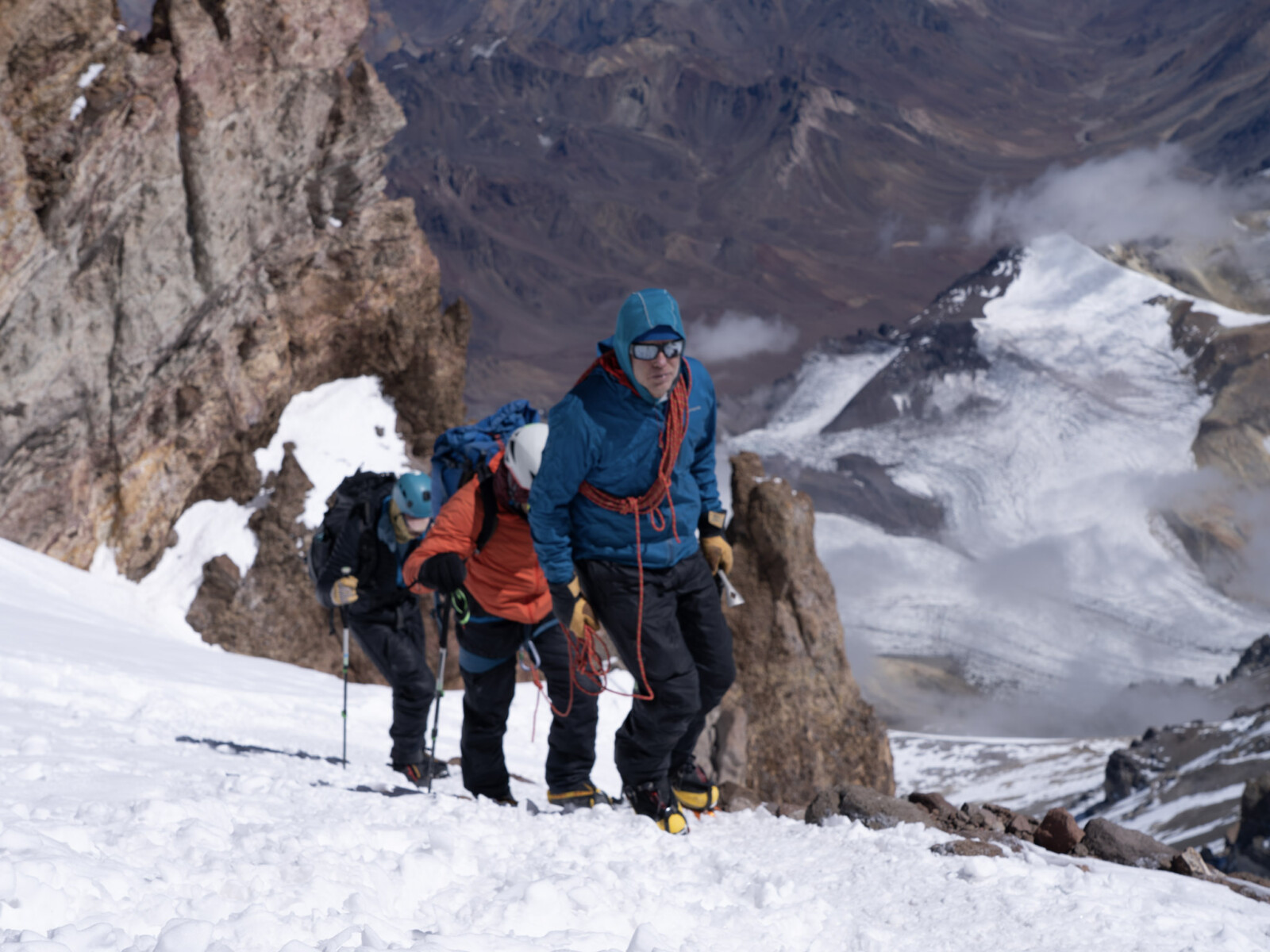
Depending on snow and mountain conditions, the upper mountain may require crampons and an ice axe. You do not need to arrive as an expert in their use; our guides can teach and review the necessary skills. You do need to arrive fit enough to move steadily and safely while using them.
Motivated climbers on their first major expedition can succeed here. What we look for is excellent fitness, genuine commitment to preparation, good judgment and a willingness to learn.
Who Does Well on Aconcagua
After decades on this mountain, we have learned that the strongest athlete is not automatically the strongest expedition climber.
People who do well tend to:
- Pace themselves with discipline rather than racing the group.
- Eat, drink and rest deliberately, even when they don’t feel like it.
- Communicate honestly about how they are feeling — and do it early.
- Participate as members of the expedition team.
- Look after themselves while remaining aware of the people around them.
- Accept guide decisions, including the difficult decision to turn around.
If that sounds like how you already operate in the mountains — or how you want to learn to operate — Aconcagua may be an excellent next step.
Be Honest With Yourself
Aconcagua may not be the right objective right now if:
- You need a guaranteed summit to consider the expedition worthwhile.
- Your schedule cannot accommodate serious training before departure.
- You are uncomfortable carrying significant loads over consecutive mountain days.
- You are unwilling to communicate openly about symptoms or fatigue.
- You cannot accept that weather, health or the guide team’s judgment may require turning around.
Turning around can be the correct decision on Aconcagua. Summit or no summit, the objective is for the entire team to return safely with meaningful expedition experience.
Where Aconcagua Fits
For some climbers, Aconcagua is the defining objective — the biggest mountain they ever intend to climb.
For others, it is a step toward Denali, the Himalaya or another high-altitude objective. And for some, it is part of completing the Seven Summits.
There is no ladder you are supposed to be on.
What matters is whether this mountain fits your experience, preparation and goals.
Not Sure? Ask Us.
You do not need to decide whether you’re “an Aconcagua climber” by yourself.
Tell us what you have climbed, what your training looks like, how much time you have before departure and what you want from the expedition.
Every climber is personally reviewed before booking. We would rather help you choose the right mountain than sell you the wrong one.
Before You Go: Start Here
Aconcagua Normal Route · Your Preparation Roadmap
The climbers who arrive in Mendoza relaxed are the ones who handled the paperwork months ago, not weeks.
This section puts everything in order — what to do, when to do it, and where to find the details. Handle the logistics early, and your energy in the final weeks can go into training rather than paperwork.
When You Book
- Submit your Trip Application & Medical History Form, liability waiver, emergency contacts and passport copy — all provided by BBE at booking.
- Check your passport: it should be valid for at least 6 months beyond your return date.
- Start structured training — see Is This Trip for Me? for what you should be building toward.
- Read the Gear & Equipment list now so major purchases, especially boots and sleeping bag, have time to be tested before the expedition.
3–6 Months Before
- Book flights to Mendoza (MDZ) after your departure has been confirmed by BBE. Consider flexible or refundable fares.
- Purchase the required rescue and medical evacuation coverage for high-altitude mountaineering.
- Break in your boots and test your complete layering system during real training days.
- Continue your structured Aconcagua training program.
6–8 Weeks Before
- Send BBE your flight itinerary and insurance certificate.
- Confirm the current entry requirements for Argentina for your nationality.
- Complete any remaining permit information requested by BBE.
- Review your equipment again and resolve anything that is still missing.
The Final 2 Weeks
- Do a complete pack-out using the BBE gear list — every item, packed the way it will travel.
- Prepare the cash you will need for the current-season climbing permit, gratuities and personal expenses.
- Make digital copies of your passport, insurance certificate and important travel documents.
- Taper your training. Arrive rested, not exhausted.
Arrival Day
A member of the BBE team meets you at Mendoza Airport.
That evening, the team gathers for orientation, the first equipment review and a welcome dinner. This is the time to resolve any final equipment or logistical issues before we leave Mendoza for Las Cuevas.
From this point forward, the expedition has begun.
Your Preparation Sections
Use the sections below for the detailed information you need:
- Documentation & Insurance — passport, forms, climbing permit and required rescue/evacuation coverage
- Travel Planning — flights, Mendoza arrival and departure planning
- Hotels, Lodging & Camps — where you will stay throughout the expedition
- Gear & Equipment — the complete expedition equipment requirements
- Daily Life on the Expedition — food, camps, communication and what expedition life actually feels like
- Local Expenses & Tipping — permit, personal expenses, cash and gratuities
- Private & Custom Expeditions — private dates, your own team and customized options
Questions While You Prepare?
Preparation questions are exactly what we are here for — gear choices, training doubts, insurance fine print or flight timing.
Ask early. Small questions are much easier to solve months before departure than a few days before you fly.
What to Budget For
Aconcagua Normal Route · The Complete Cost Picture
The expedition price is only one part of the total cost of climbing Aconcagua.
Beyond your BBE expedition fee, you should budget separately for the climbing permit, flights, insurance, gratuities, optional personal porter support, personal equipment and expenses before and after the expedition.
We want you to understand those costs before you book, not discover them in Mendoza.
For the expedition price itself, departure dates and booking terms, see Dates & Prices.
What Your Expedition Fee Includes
Your BBE expedition fee covers the core program from your arrival in Mendoza through the scheduled end of the expedition, including:
- Scheduled ground transportation during the expedition, including airport pickup on arrival
- Mendoza hotel accommodations as specified in the itinerary
- Las Cuevas lodging during the pre-acclimatization program
- Expedition meals as specified in the itinerary
- Plaza de Mulas Base Camp services and meals
- Group expedition tents, stoves, cooking equipment and camp systems
- Mule transportation for designated loads during the approach to Base Camp
- Upper-mountain support for designated group loads according to the expedition operating plan
- Professional guide team throughout the expedition
- Expedition communications and group medical/emergency equipment
Personal porter service above Base Camp is not included unless specifically listed in your confirmed expedition package.
For the definitive inclusion list for your departure, see Dates & Prices and your booking confirmation.
What Is Not Included
Plan separately for:
- Aconcagua climbing permit — permit fees are established by Mendoza Province and can change by season. BBE will provide the current amount and payment instructions before departure.
- International and domestic airfare to and from Mendoza
- Required rescue and medical evacuation coverage
- Trip cancellation and travel insurance, strongly recommended
- Personal climbing clothing and equipment
- Optional personal porter support above Base Camp
- Guide and staff gratuities
- Excess baggage charges
- Personal snacks and beverages
- Wi-Fi, showers and other personal purchases at Base Camp
- Additional hotel, transportation, meal or logistical costs resulting from an early departure, evacuation, personal itinerary changes or delays outside BBE’s control
- Airport transfer after the expedition — departure times vary, and BBE can help arrange transportation
Rescue & Medical Evacuation Coverage — Required
Rescue and medical evacuation coverage is required for this expedition.
Your coverage must be appropriate for high-altitude mountaineering on Aconcagua and include emergency evacuation and medical transport appropriate to the altitude and location of the expedition.
Standard travel insurance may exclude mountaineering or impose altitude limits, so read the policy carefully rather than assuming you are covered.
BBE will provide the current insurance requirements before departure. See Documentation & Insurance for details.
Trip Cancellation & Travel Insurance — Strongly Recommended
This is different from rescue and evacuation coverage.
Travel insurance can provide protection for circumstances such as trip cancellation or interruption, travel delays, missed connections, baggage problems and other covered travel disruptions.
Because these products, exclusions and prices change, compare coverage based on your own circumstances and the expedition dates.
Optional Personal Porter Support
BBE’s expedition logistics include support for designated group loads, but you remain an active member of the expedition and should arrive prepared to carry your own upper-mountain load.
Personal porter support may be hired separately on the mountain when available. Many climbers choose porter assistance for one or more upper-mountain carries to reduce their load and conserve energy.
Porter prices vary by camp and season. Contact us for current rates rather than budgeting from an old price list.
Your guide team can also help you decide whether personal porter support makes sense based on how you are moving and acclimatizing.
Gratuities
Guide and staff gratuities are not included in the expedition price.
Tipping is customary but discretionary. We provide current guidance before departure so you can plan appropriately and understand how gratuities are normally distributed among the people supporting the expedition.
See Local Expenses & Tipping for details.
Personal Gear
For someone who already owns a complete mountaineering system, additional equipment costs may be relatively small.
For a first major high-altitude expedition, equipment can represent a significant additional investment — particularly double boots, sleeping bag, expedition insulation, shell clothing, gloves and other cold-weather equipment.
Do not buy equipment based only on an estimated dollar figure. Start with the BBE Gear & Equipment list and determine what you already own, what needs replacing and what you actually need to purchase.
Build a Personal Expense Buffer
In addition to the major costs above, plan for:
- Baggage fees
- Personal snacks
- Base Camp Wi-Fi, showers and beverages
- Meals and personal expenses outside the included itinerary
- Optional porter support
- Additional Mendoza expenses
- Unexpected travel changes
We recommend traveling with both accessible funds and a financial reserve, rather than budgeting the expedition to the last dollar.
The Simple Way to Think About Your Aconcagua Budget
Your total trip budget consists of:
BBE expedition fee
- Aconcagua permit
- airfare
- required rescue/evacuation coverage
- travel insurance
- personal equipment
- gratuities
- optional porter support and personal expenses
The first number most people see is the expedition price.
The number that matters for planning is the complete cost of getting yourself to Aconcagua, climbing it, and getting home.
Questions About Costs?
If you are comparing Aconcagua programs and are unsure whether two prices include the same services, ask us.
We are happy to walk through the costs with you so you understand what is included, what is optional and what you should realistically budget before making a decision.
Aconcagua Expedition Dates & Prices
Normal Route · 19 Days · Maximum 6 Climbers
Our scheduled Aconcagua expeditions are intentionally small. Each public departure is limited to six climbers, allowing the guide team to know how each person is acclimatizing, recovering and performing as the expedition moves higher.
Before accepting a registration, BBE reviews each climber’s experience, fitness and preparation. Aconcagua should not be selected simply because the dates and price work — it should be the right mountain for you.
2026–2027 Scheduled Departures
Early Season
November 29 – December 17, 2026 · Open
Prime January / MLK
January 9 – January 27, 2027 · Open
Late Season
February 6 – February 24, 2027 · Open
Availability can change. A place is confirmed only after BBE accepts your application and receives the required deposit.
Expedition Price
$8,500 USD per climber
19 days · Maximum 6 climbers · Minimum 3 climbers
The scheduled expedition price is based on shared accommodations where applicable.
This is a complete 19-day expedition — beginning with staged pre-acclimatization in the Las Cuevas area before entering Aconcagua Provincial Park, and continuing through the Normal Route to the upper mountain and summit attempt.
Team Size & Guide Staffing
All scheduled public departures are capped at six climbers.
1–3 climbers: One climbing guide
4–6 climbers: One lead guide, with an assistant guide joining at Plaza de Mulas Base Camp for the upper mountain
During the approach, the guiding structure is based on one guide for up to three climbers. For teams of four to six, the additional guide joins at Base Camp for the climbing portion above Plaza de Mulas.
Plaza de Mulas also has a full local service team, including camp staff, cooks and operational support. Base Camp staff are not counted as climbing guides.
Every expedition is led by an internationally or nationally certified guide selected according to BBE standards and supported by the appropriate local team.
Willie or Damian Benegas personally guiding a departure is not guaranteed unless their participation is specifically confirmed in writing.
What’s Included
- Pre-trip readiness review, planning and equipment guidance
- Scheduled airport pickup in Mendoza
- Ground transportation required by the itinerary
- Two scheduled hotel nights in Mendoza
- Lodging during the Las Cuevas acclimatization phase
- Meals as specified in the final itinerary
- Full meal service at Plaza de Mulas Base Camp
- Mountain tents and camp systems
- Mule transportation for designated expedition loads
- Upper-mountain support for designated group loads according to the operating plan
- Certified climbing-guide team
- Local Base Camp and operational support
- Group cooking equipment and fuel
- Designated group technical and safety equipment
- Expedition medical kit and emergency equipment
- Radio or satellite communication systems appropriate to the expedition
- Aconcagua permit paperwork and processing
What’s Not Included
- International or domestic airfare
- Aconcagua Provincial Park climbing permit fee
- Passport, visa or entry expenses
- Rescue and medical evacuation insurance
- Trip cancellation and interruption insurance
- Personal clothing and mountaineering equipment
- Equipment rentals
- Personal porter services beyond the support specifically included
- Guide and staff gratuities
- Personal snacks, drinks and summit food
- Showers, internet, beverages and other personal Base Camp purchases
- Excess baggage charges
- Meals in Mendoza not specifically listed in the itinerary
- Additional hotel nights caused by early arrival, delayed departure or itinerary changes
- Unscheduled transportation or lodging
- Medical treatment, evacuation or repatriation
- Expenses resulting from weather, illness, flight disruptions, government action or circumstances outside BBE’s control
- Additional mountain or Base Camp days beyond those included in the scheduled itinerary
For a more complete picture of the expenses beyond the expedition price, see What to Budget For.
Aconcagua Climbing Permit
The Aconcagua Provincial Park climbing permit is not included in the BBE expedition price.
BBE handles the permit paperwork and processing as part of the expedition service. The client remains responsible for the permit fee.
Permit prices and procedures are determined by the Government of Mendoza and can change by season. BBE will provide the current amount and payment instructions before departure.
Do not rely on permit prices from previous seasons when preparing your final budget.
Deposit & Final Payment
A deposit equal to 20% of the expedition price is required to reserve an accepted place.
For the $8,500 scheduled expedition:
Deposit: $1,700
Final balance: Due 120 days before departure
Registrations made within 120 days of departure require full payment at booking.
Complete payment methods, processing fees and booking conditions are provided during registration.
Cancellation
All cancellations must be submitted in writing.
121 days or more before departure: Payments refunded according to the BBE International Programs Policy, less applicable non-refundable booking fees and unrecoverable costs.
91–120 days: 50% of eligible payments beyond applicable non-refundable fees.
61–90 days: 25% of eligible payments beyond applicable non-refundable fees.
60 days or less: No refund.
Refunds are not provided for unused expedition services after the expedition begins, failure to reach the summit, voluntary withdrawal, insufficient preparation, altitude illness, weather or mountain conditions, or other circumstances covered by the BBE International Programs Policy.
The complete BBE International Programs Policy provided during registration controls if there is any conflict with this summary.
Trip cancellation and interruption insurance is strongly recommended.
Private & Custom Aconcagua Expeditions
Private departures are available for climbers who want different dates, their own team, additional acclimatization, increased porter support or a program designed around specific needs.
Private expeditions can be designed for individual climbers, couples, families, groups of friends, clubs, organizations and corporate teams.
Pricing depends on group size, dates, guide staffing, porter support and the final logistical plan.
Participation by Willie or Damian Benegas is available when specifically confirmed in the written proposal.
Before You Register
We recommend reviewing:
The Climb · Day by Day · Is This Trip for Me? · What to Budget For · Before You Go
If you’re uncertain whether Aconcagua is the right next mountain, talk with us.
We would rather help you choose the right expedition than sell you the wrong one.