Global Expeditions Tanzania

Kilimanjaro Rongai

10 Days Group: 8 people From $5,300 per Person

Kilimanjaro is one of the only mountains on earth where a person who has never climbed before can reach a genuine expedition summit. No ropes. No technical gear. No mountaineering background required. At some point, you decided you wanted to do something that actually required something of you. Kilimanjaro is that mountain.

The Mountain

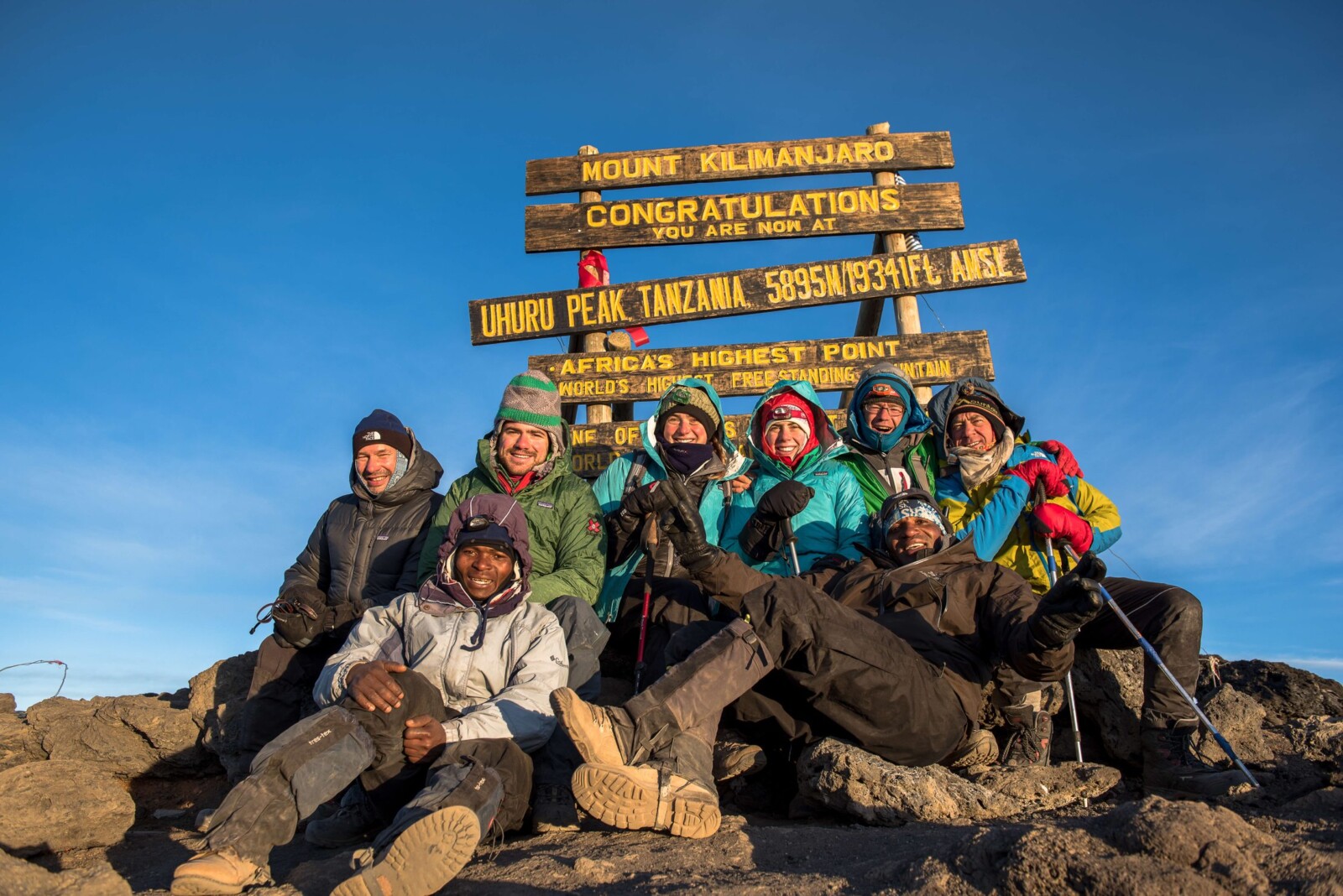
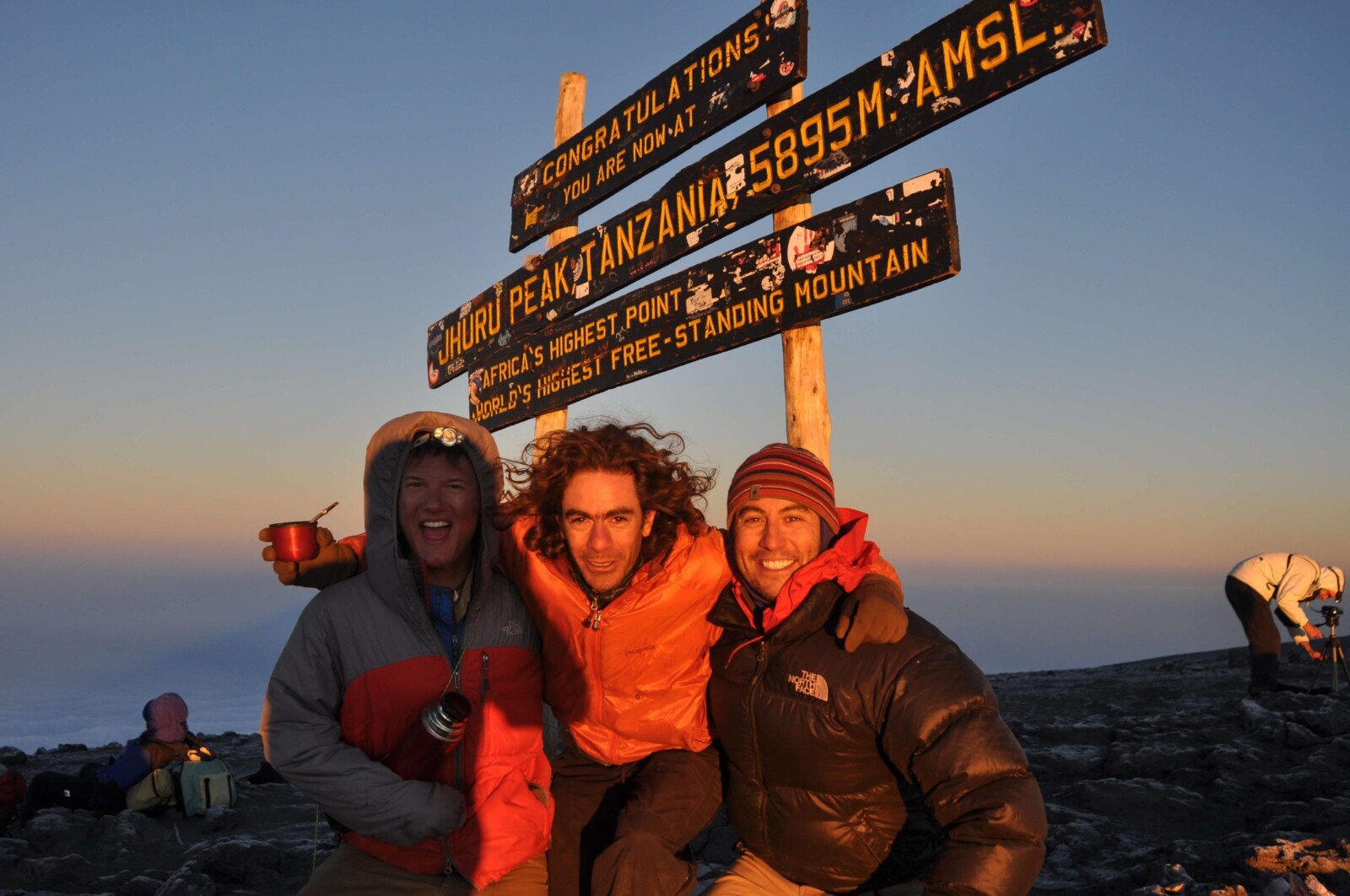
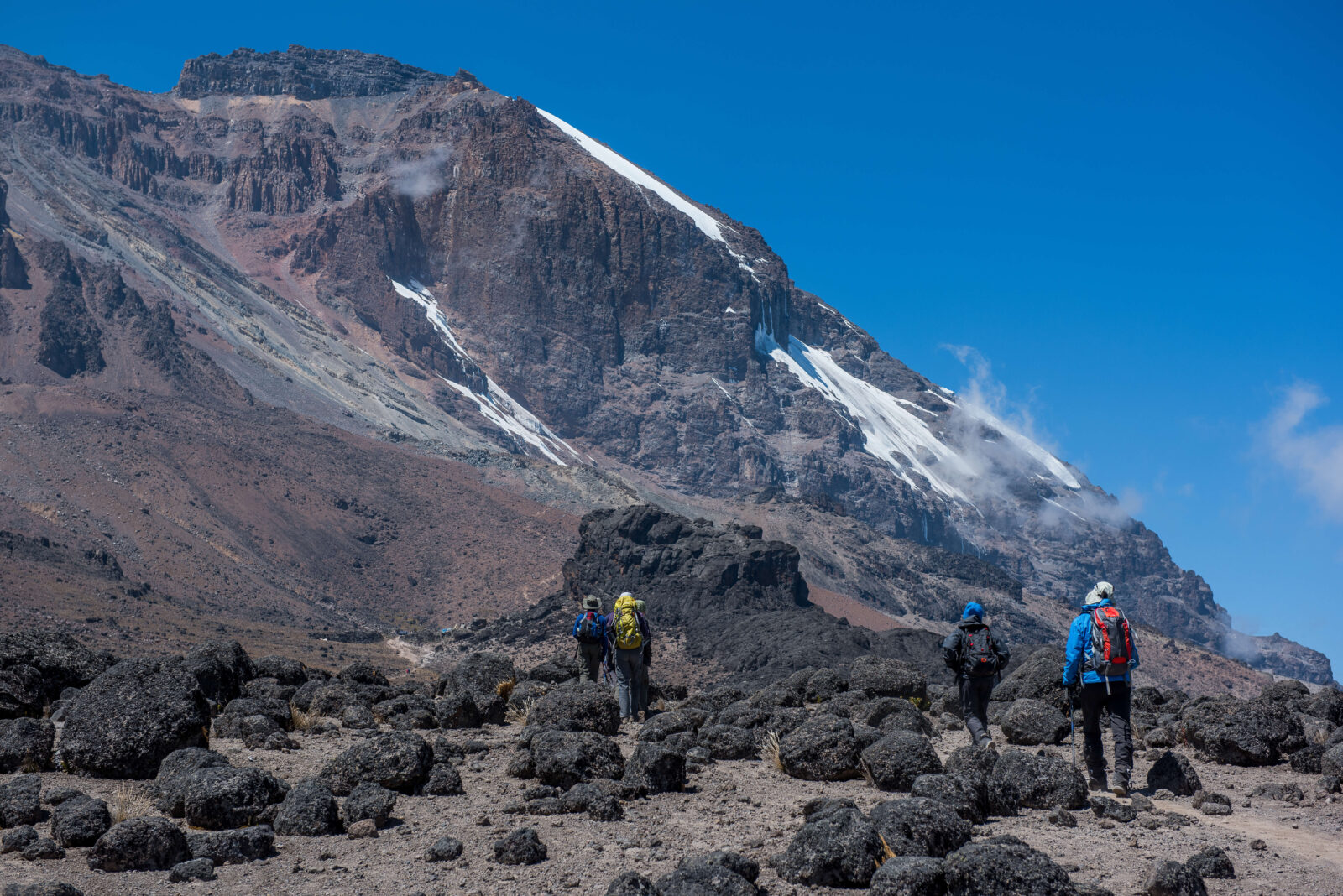
Mount Kilimanjaro rises to 19,341 ft / 5,895 m above the plains of Tanzania. It is the highest mountain in Africa, the highest free-standing mountain in the world, and one of the legendary Seven Summits. At Benegas Brothers Expeditions, we approach it as a managed high-altitude expedition designed to support you through every stage of the process — not just a trek to the top.

The climb crosses five distinct ecological zones — from tropical rainforest to alpine desert — before arriving at its glaciated summit. Each one feels like a different world. The summit is the goal. The climb is the experience. For more on the mountain’s natural history, see tanzaniaparks.go.tz.

Why We Climb Rongai

Unlike the crowded southern routes, Rongai offers a quieter, more deliberate ascent. The trail moves through forest, moorland, and alpine desert, gradually exposing the scale of Kilimanjaro while allowing your body to adapt naturally. Fewer crowds, cleaner air, and a steady rhythm define the Rongai approach. Over ten days, you complete a full north-to-south traverse of Africa’s highest peak.

The School Hut Strategy

Most teams stage their summit push from the heavily trafficked Kibo Hut. We don’t. By staging from School Hut (15,585 ft / 4,750 m), we position our team away from traffic — allowing for a calm, focused summit push shaped by internal rhythm rather than external pressure. Breathing, pacing, and focus take priority over speed. Most operators skip this step to simplify logistics. We consider it one of the most important decisions we make for summit day.

The BBE Approach

Built on over 35 years of high-altitude experience on Everest, Aconcagua, and the world’s highest peaks, the BBE guide team operates under a system developed by Damian and Willie Benegas. The objective is not to push harder — it is to move smarter. From the first day on the mountain, our guides are teaching you how to regulate your breathing, manage your effort, and find your rhythm in thin air. Our guides hold IFMGA certification (ifmga.info) — the highest internationally recognized standard in the profession.

Why Six Climbers

We cap every departure at six climbers. That single decision changes how the expedition runs — how well your guide knows you, how pace decisions are made, how the summit call happens.

  • Personal pacing — adjusted for you individually, not the group average
  • Daily monitoring — your guide reads how you are adapting and adjusts in real time
  • Stronger team dynamic — six people over ten days becomes a genuine bond
  • Better decisions — summit calls made with full knowledge of each climber
  • Quieter camps — more organized, more focused, more personal

Is This for You?

This expedition works for a wide range of people. What they share is not a background — it’s a mindset:

  • First-time high-altitude climbers who want to do this properly, with a team that takes it seriously
  • Experienced hikers and trekkers ready to take on a real altitude objective
  • Climbers using Kilimanjaro as a stepping stone toward Aconcagua, Denali, or the Himalaya
  • Couples, close friends, or small groups looking for a shared challenge that actually means something
  • Anyone who decided to do something extraordinary and wants the right team beside them

You do not need a technical climbing background. You need commitment, preparation, and the right attitude. Every climber we guide is interviewed before booking. See the Is This Trip for Me? section for the full honest picture.
10 Days  ·  Rongai Route  ·  North-to-South Traverse

Total distance: ~78 km / 48.5 miles  ·  Elevation gain/loss: +4,645 m / -4,645 m  ·  Summit: Uhuru Peak, 19,341 ft / 5,895 m

Phase 1: Arrival & Preparation – Day 1-2
Phase 2: The Ascent & Acclimatization – Day 3-7
Phase 3: Summit Day – Day 8 
Phase 4: Descent & Return – Days 9-10

Your journey begins at the foot of the mountain with a private transfer from Kilimanjaro International Airport (JRO). This is a day for rest and recovery — Kilimanjaro looms in the distance, present but understated. Hydrate, rest, and allow your body to begin adapting.

Sleeping altitude: ~2,950 ft / ~900 m

Our team conducts a full gear check, ensuring everything is ready for conditions ranging from equatorial heat to sub-zero temperatures. A light walk through local coffee farms introduces steady, intentional movement before the expedition begins.

Sleeping altitude: ~2,950 ft / ~900 m

We enter the northern forest via the Nale Moru Gate. This side is drier and quieter, home to Black and White Colobus monkeys. From the start, we focus on slow, steady movement and controlled breathing.

Sleeping altitude: Simba Camp: 8,610 ft / 2,625 m

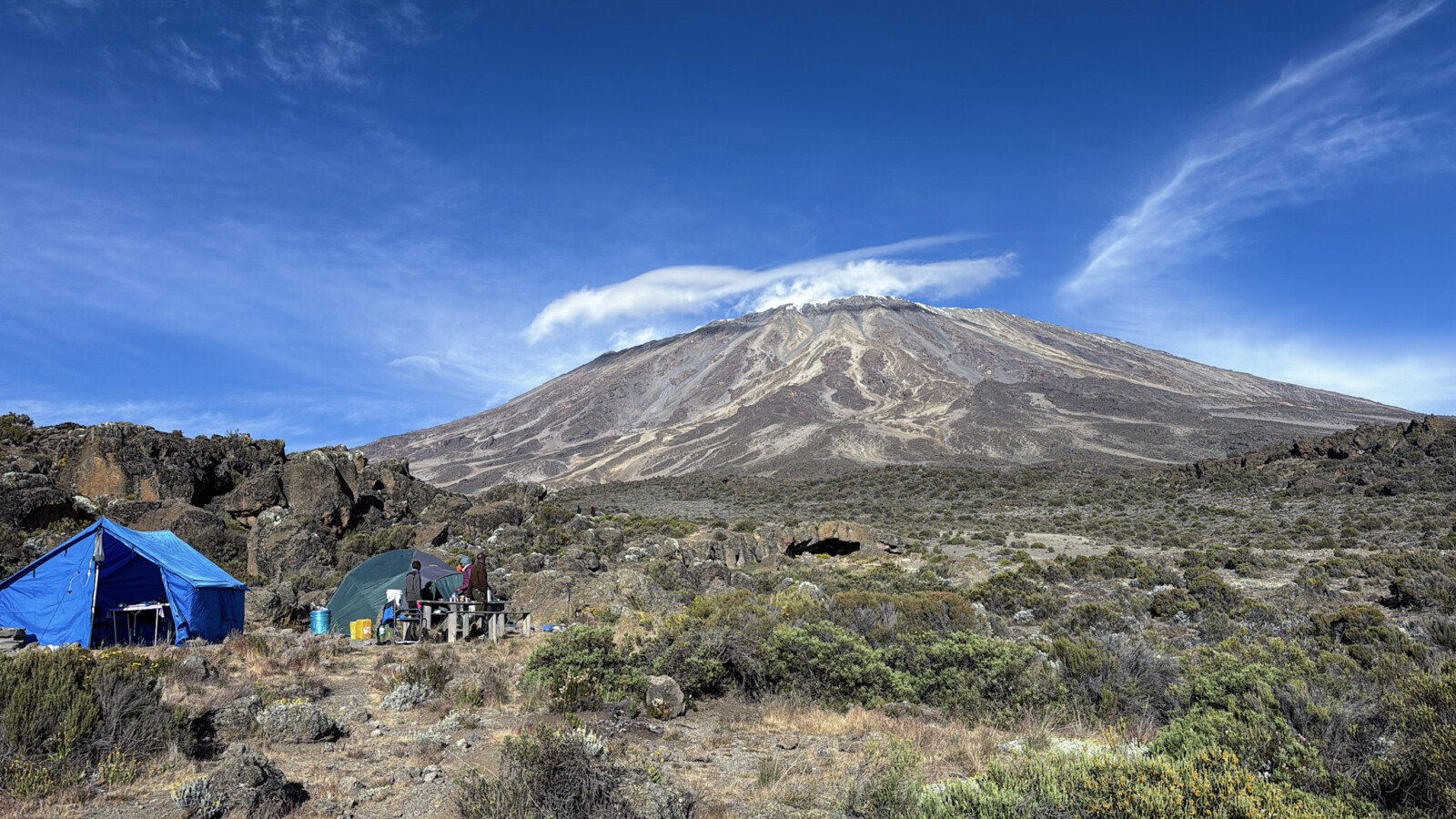
As we move into the moorland, the terrain opens up. Vegetation becomes sparse and the landscape shifts to volcanic rock and low flora. Our guides monitor how everyone is adapting to the altitude.

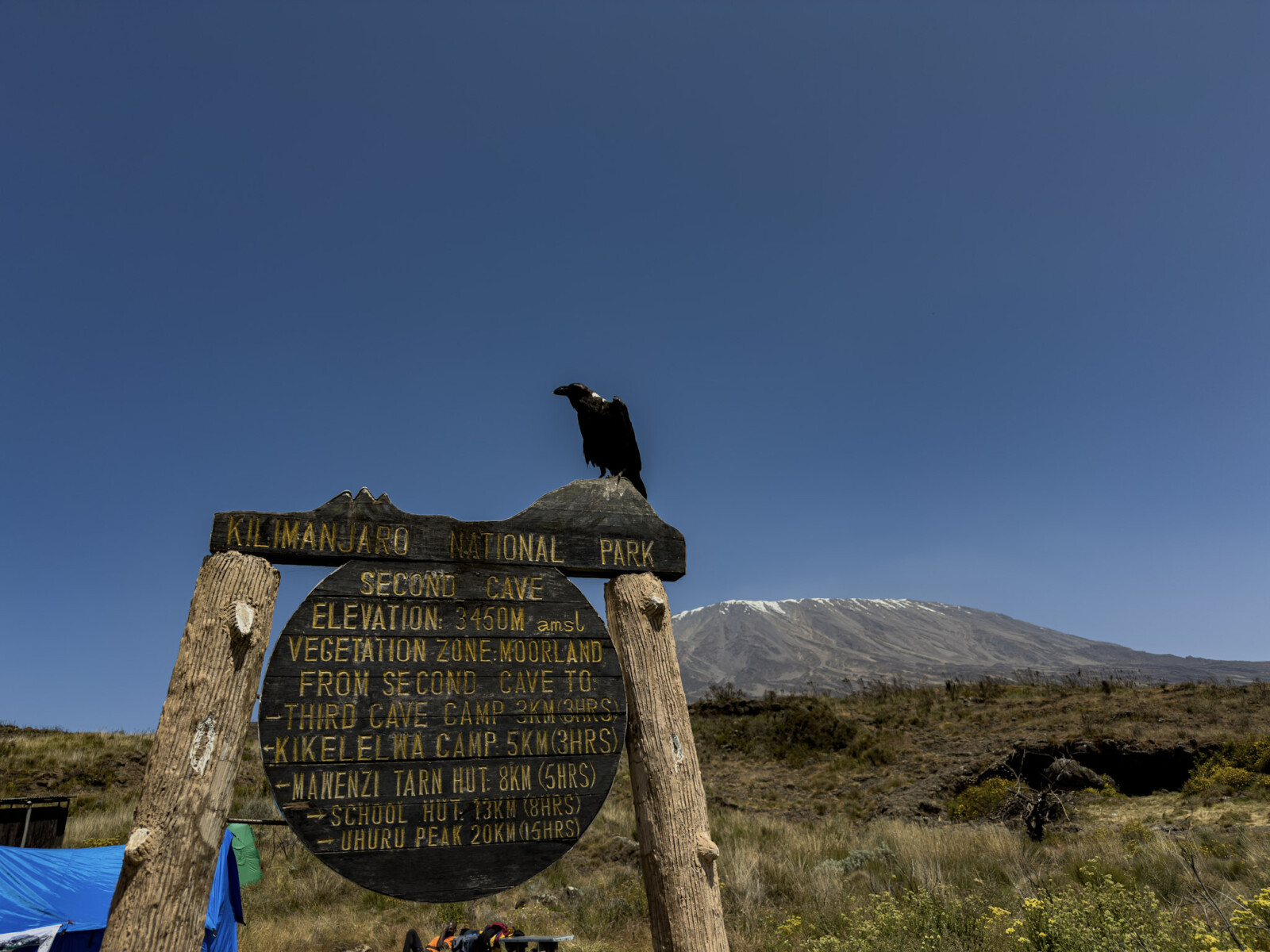
Sleeping altitude: Second Cave: 11,320 ft / 3,450 m

A shorter day designed for recovery. Arriving early allows the body time to adapt, supporting the acclimatization process. Strong recovery days are often the margin between a summit and a turnaround.

Sleeping altitude: Third Cave: 12,795 ft / 3,900 m

Following the ‘Climb High, Sleep Low’ principle, we hike up into the alpine desert before returning to camp. This helps the body adjust more efficiently to altitude and builds confidence for the days ahead.

Sleeping altitude: Third Cave: 12,795 ft / 3,900 m  ·  Max: 15,585 ft / 4,750 m

We cross the high-altitude plateau known as The Saddle and reach School Hut — our summit staging area. Quieter and less crowded than the standard Kibo Hut, this camp allows for proper rest and focus before summit day. The afternoon is intentional: eat, drink, organize your summit pack, sleep early. Tomorrow begins at midnight.

Sleeping altitude: School Hut: 15,585 ft / 4,750 m

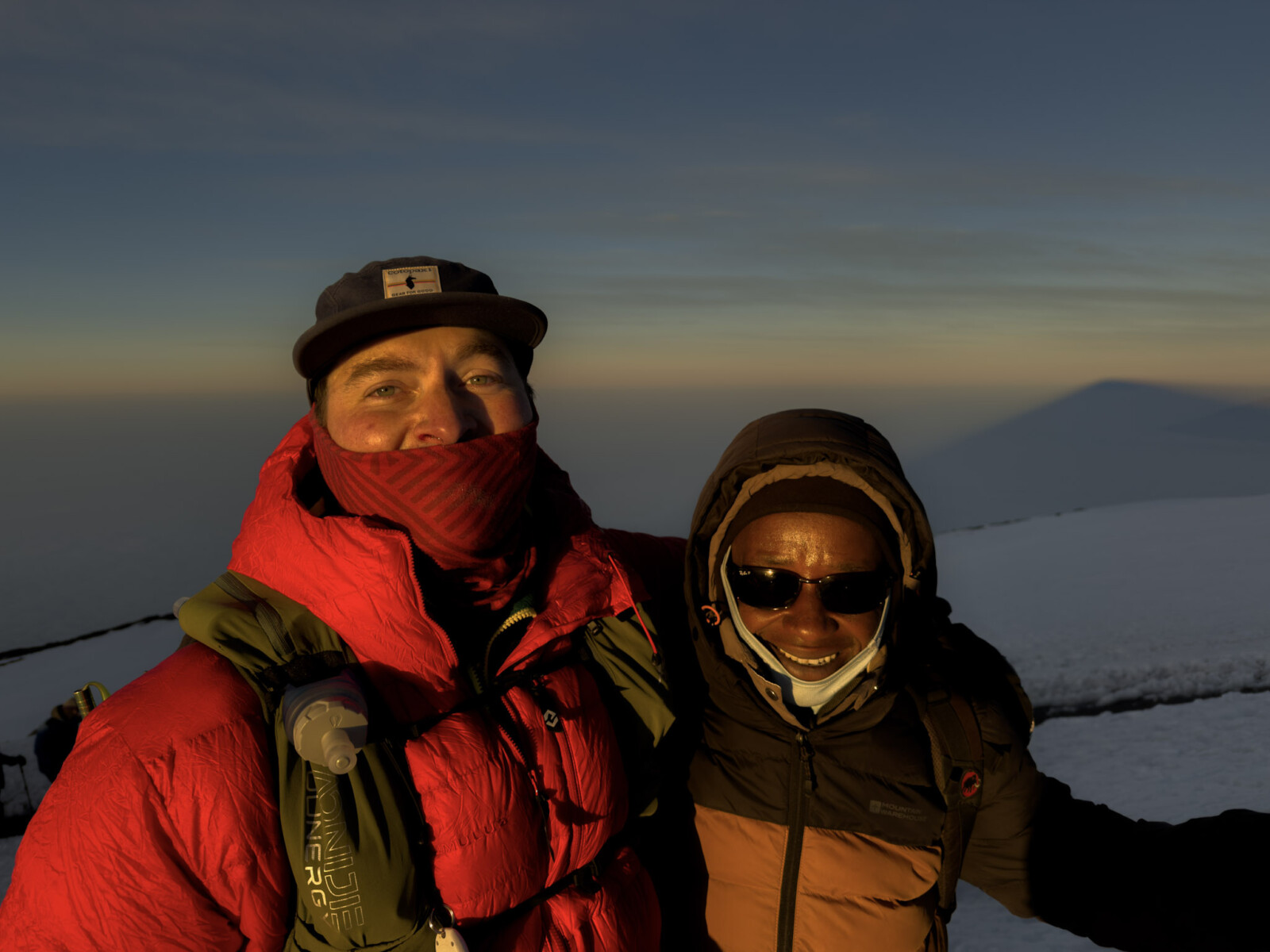
We begin around midnight, moving slowly and steadily through the high desert. The climb continues up steep scree slopes toward Gilman’s Point, where we reach the crater rim at sunrise at approximately 18,638 ft / 5,681 m. From there, we continue along the ridge to Uhuru Peak at 19,341 ft / 5,895 m — the highest point in Africa. After a short time on the summit, we descend back past Gilman’s Point and continue down to Horombo Hut. The descent is long and requires focus and steady pacing.

Sleeping altitude: Horombo Hut: 12,205 ft / 3,720 m  ·  Max: Uhuru Peak 19,341 ft / 5,895 m

We descend through changing landscapes, from moorland into rainforest. As oxygen levels increase, movement becomes easier. At Marangu Gate (5,068 ft / 1,545 m), we receive our summit certificates before returning to Moshi for a hot shower and a well-earned meal.

Sleeping altitude: Moshi: ~2,950 ft / ~900 m

The morning is open for rest and packing before your private transfer to the airport or continuation to a safari or Zanzibar extension. Services conclude in Moshi. Safari and Zanzibar extensions available — contact us at booking.

An honest answer. Not a sales pitch.

You Don’t Have to Be a Climber

Most of the people who climb Kilimanjaro with us have never done anything like it before. They are fit. They hike on weekends, maybe run a few times a week. They are not professional athletes and they are not mountaineers. They just decided, at some point, that they wanted to do something that actually required something of them.

The mountain is non-technical — no ropes, no technical gear, no prior mountaineering experience required. What it does require is honest preparation, real fitness, and the willingness to face a genuinely hard day at the end of ten good ones.

Fitness Required

Kilimanjaro demands real physical preparation — not elite athleticism, but consistent, intentional training over several months. You should arrive capable of:

  • Hiking 6–8 hours per day on uneven terrain with a 20–35 lb pack
  • Repeating sustained effort on consecutive days without full recovery
  • Moving steadily uphill for extended periods at a slow, controlled pace
  • Functioning well in cold, dark, uncomfortable conditions when fatigued

The benchmark that matters most: can you sustain steady uphill movement for 8+ hours when you are already tired from the days before? That is summit night. Train for that specifically.

What Will Feel Hard

The Midnight Start

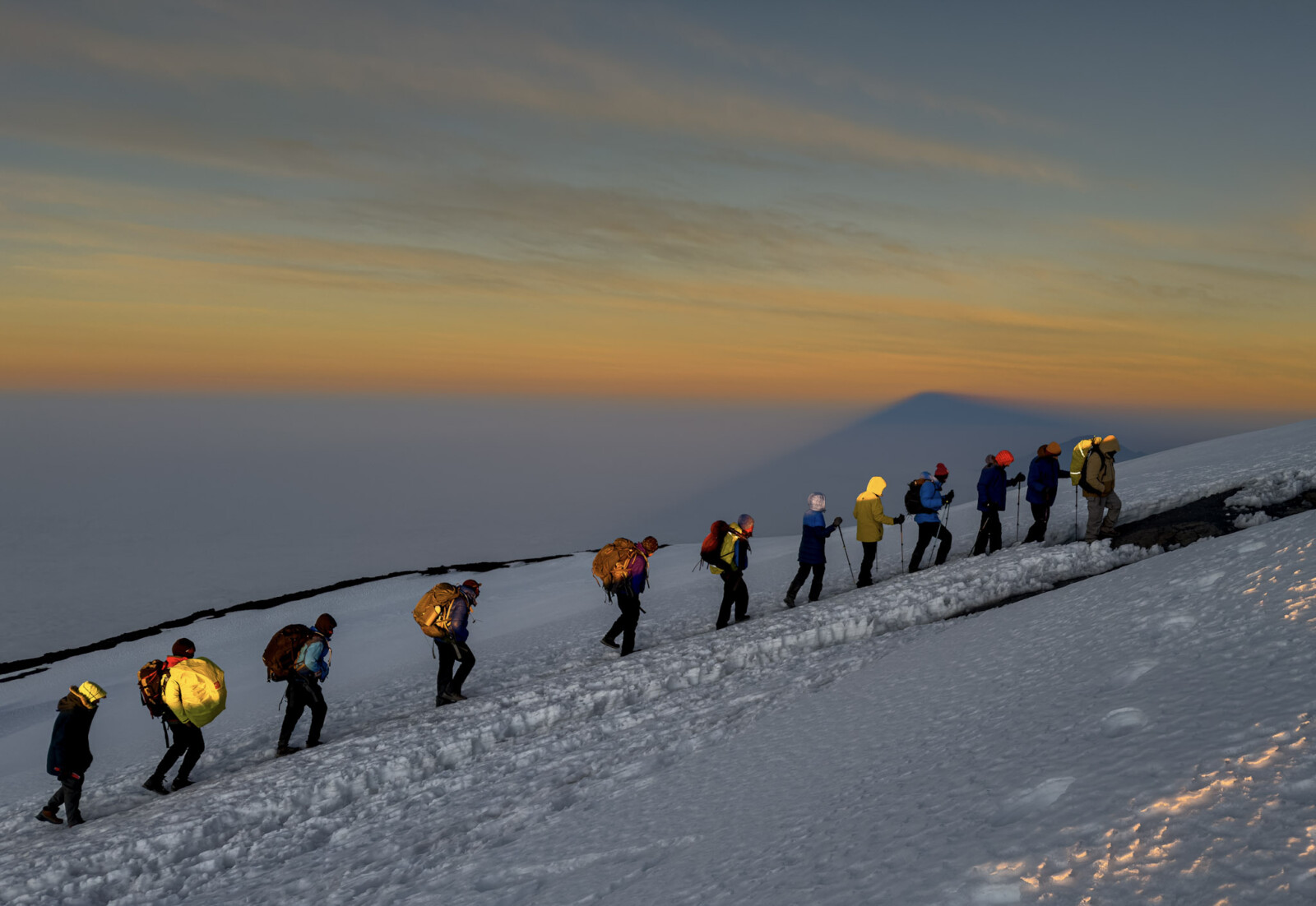
You start around midnight. You have been trying to sleep since early evening — badly, at altitude, in the cold, knowing what is ahead. The alarm goes. You dress in every layer you have. You step outside into darkness and cold that feels different from anything below. Then you walk. Slowly. For hours. Into nothing but headlamp light and the sound of your own breathing.

The Cold

Temperatures between midnight and dawn regularly drop to -15°C to -20°C / 5°F to -4°F or colder on the upper mountain. Wind makes it worse. No matter how well you are dressed, you will feel it.

The Scree

The upper slopes are loose volcanic scree — two steps up, one step slides back. It is exhausting, slow, and demoralizing if you are not prepared for it mentally. Your guides will tell you to expect it. Listen to them.

The Altitude

Between School Hut (15,585 ft / 4,750 m) and Uhuru Peak (19,341 ft / 5,895 m) you climb roughly 3,756 ft in a single push. At that elevation, your body is working with roughly half the oxygen available at sea level. Every step is harder than the last. This is not a fitness problem — it is altitude, and it affects every human body on the mountain.

“We would rather you arrive knowing it will be hard than arrive expecting it to be manageable and be blindsided at 5,000 meters in the dark.”


How to Prepare

Start at least three months before departure. Six months is better. Consistency matters far more than intensity.

  • Back-to-back long days with a loaded pack — the single most important preparation; consecutive hiking days simulate what the mountain asks of you
  • Night hiking — summit night starts at midnight; the psychological adjustment is real
  • Cold exposure — winter hikes and early cold mornings; managing cold while moving is a skill worth practicing
  • Uphill endurance, not speed — train at the pace you can sustain for eight hours
  • Mental preparation — read what summit night feels like; know your reasons for being there

A full week-by-week training guide is provided to every confirmed climber. A strong external resource is uphillatlete.com.

Real questions from people considering this expedition. Direct answers.

Yes. Most of our clients haven’t. Kilimanjaro does not require mountaineering experience, technical skills, or a climbing background. It requires fitness, the right mindset, and a real preparation process. Contact us before booking and we will have an honest conversation about where you are and what preparation would look like.

Harder than most people expect. The trekking days are demanding but manageable with proper preparation. Summit night is a different level — cold, dark, high altitude, loose terrain, and a midnight start after days of accumulated effort. Read the Is This Trip for Me? section before you book.

It happens. Altitude affects every body differently. What we can guarantee is that the decision to turn around will always be made with your health and safety first, by guides who know you and the mountain well. Many climbers who don’t summit still describe the expedition as one of the best experiences of their lives.

Summit day. It begins around midnight and typically involves 12 to 15 hours of continuous movement — 8 to 10 hours of ascent followed by 5 to 7 hours of controlled descent, in cold, dark, high-altitude conditions. Everything else on the itinerary builds toward that day.

Lower camps are often mild. Summit night is a different environment. Expect -10°C to -20°C (14°F to -4°F) or colder before sunrise on the upper mountain, with wind. Your pre-departure equipment consultation will ensure you are layered correctly.

Yes. Our Kilimanjaro program includes all park fees and climbing permits in the expedition price. This is not universal among operators — worth confirming when comparing programs.

Yes, and rescue insurance is mandatory. Your policy must cover helicopter evacuation from terrain up to 6,000 meters / 19,685 ft — most standard plans cap at 3,000 m, which is not sufficient. We recommend Global Rescue. Full coverage details are in the Before You Go section.

Budget $450–$700 USD total per climber for all gratuities — the crew tip pool, your Western guide, and incidentals. Bring tip cash in pristine U.S. bills printed in 2013 or later — Tanzanian banks reject worn or older-series bills.

Yes. Sleeping bags, trekking poles, jackets, and other essentials are available through our local partners. We advise on what to buy at home versus rent locally before your departure.

Absolutely. More than half of our programs are customized in some way. Private departures, adjusted itineraries, corporate teams, and filming or brand projects — contact us to discuss. Private 1:1 expeditions with a BBE guide start at $12,000 USD; personally with Willie or Damian Benegas starting at $22,000 USD.

Deposits are non-refundable due to permits and logistics secured in advance. If your spot can be filled by another qualified climber, we will work to provide a credit toward a future expedition whenever possible. Travel insurance covering trip cancellation is strongly recommended.

Please read this section in full. Most issues on international expeditions come from incomplete preparation before arrival.

Passport

Your passport must be valid for at least six months beyond your departure date from Tanzania and must have at least two blank pages for immigration stamps. Renew now if needed — there is no fix for an expired passport once flights are booked.

Tanzanian e-Visa — Required

All climbers must obtain a visa before traveling. Apply at least four to six weeks before departure at visa.immigration.go.tz. On-arrival processing is inconsistent and time-consuming. Some airlines have denied boarding to travelers without a pre-secured visa.

  • Processing time: typically 2–3 weeks
  • Fee (U.S. passport holders): $100 USD — Multiple Entry Visa required
  • Fee (non-U.S. citizens): ~$50 USD for an Ordinary Single Entry Visa

Print your Visa Grant Notice. Keep it in your carry-on with your passport. Photograph both and save to your phone and cloud storage before departure.

Rescue Insurance — Mandatory

Your policy must cover: high-altitude trekking and climbing to 6,000 m / 19,685 ft, emergency helicopter evacuation (typically $5,000–$10,000 USD without insurance), and minimum $300,000 USD combined medical and evacuation coverage. Recommended providers:

  • Global Rescue (globalrescue.com): gold standard for field rescue; add the High-Altitude Evacuation rider
  • Ripcord / Redpoint: combines rescue with comprehensive travel insurance
  • IMG Patriot: strong medical benefits, often paired with a Global Rescue membership

Vaccinations & Health

Consult a travel doctor four to eight weeks before departure. Common considerations for Tanzania: Hepatitis A and Typhoid, malaria prevention for lower elevations around Moshi, and Yellow Fever proof if arriving from a country with yellow fever risk. Discuss acetazolamide (Diamox) with your doctor before the trip

All climbers fly into Kilimanjaro International Airport (JRO). There are no direct flights from the United States — every itinerary requires at least one international connection. Total travel time: typically 20–30 hours.

Reliable Routing Options

  • Amsterdam via KLM
  • Doha via Qatar Airways
  • Istanbul via Turkish Airlines
  • Addis Ababa via Ethiopian Airlines

Before purchasing tickets, send your proposed itinerary to us for review. We confirm your arrival timing and coordinate your transfer. Your departure flight should be scheduled after 7:00 PM on the final expedition day to allow enough time to return from the mountain, repack, and transfer.

Airport Pickup

Upon exiting customs, your driver will be waiting with a sign bearing your name. Company: Big Expeditions & Safaris Ltd.  ·  Phone/WhatsApp: +255 754 203 301  ·  Alternate: +255 754 873 639  ·  Email: info@bigexpeditions.net. If you do not see your driver, stay at the airport and call. Do not leave with anyone not clearly associated with our team.

What to Keep in Your Carry-On

Pack your boots and one complete set of trail layers in your carry-on. If checked luggage is delayed, you can still start the expedition. Everything else can be rented in Moshi. Your boots cannot.

We strongly recommend arriving one full day before the expedition starts. All lodging throughout the program is arranged by BBE.

Moshi — Before and After the Climb

Our selected hotels in Moshi offer private or double occupancy rooms with en-suite bathrooms, hot showers, Wi-Fi, quality breakfasts, swimming pool or garden areas, and easy walking distance to gear rental shops. Single supplement available — contact us in advance.

Camp System on the Mountain

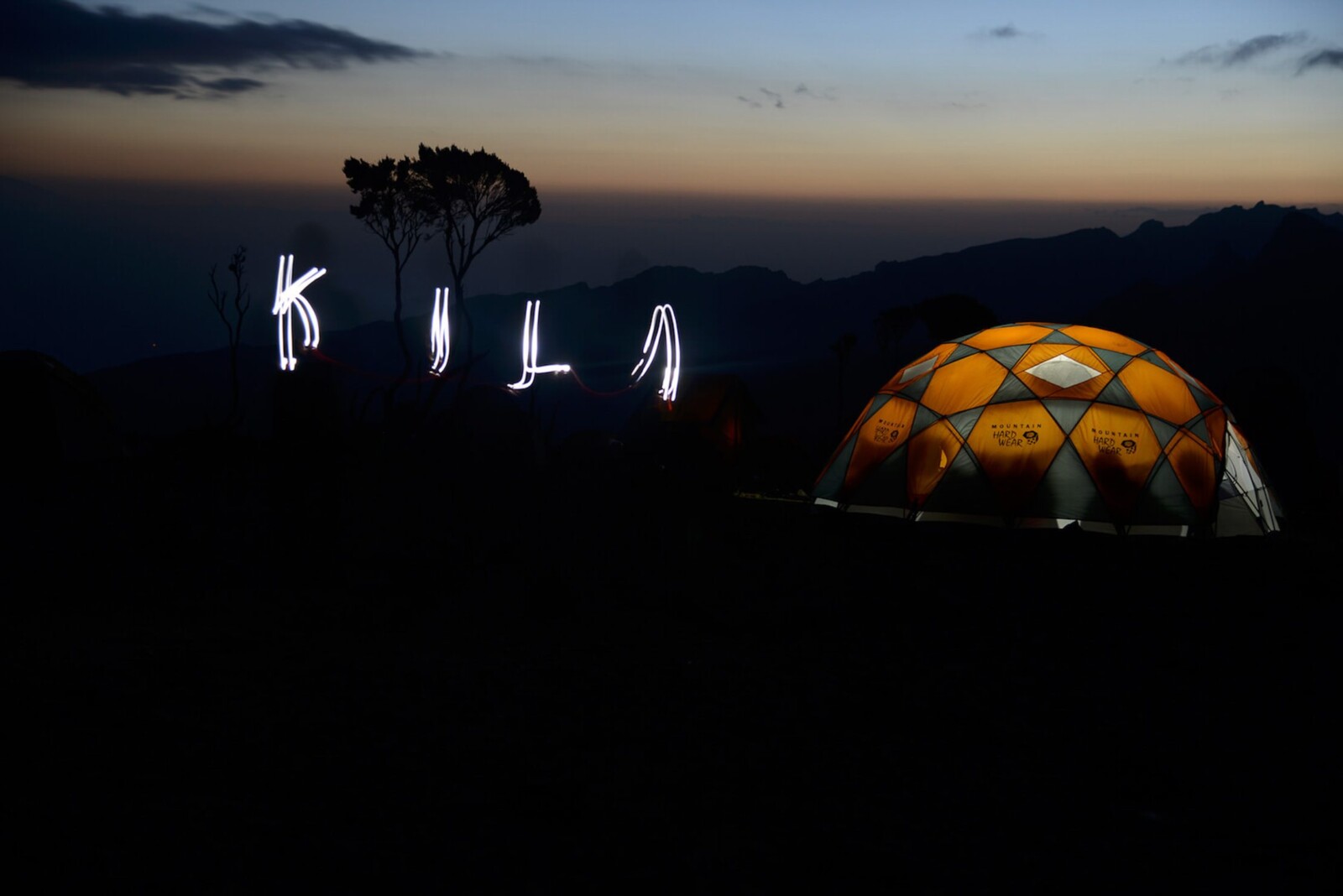
Our local crew moves ahead each day to set up camp before you arrive. Every BBE camp includes spacious sleeping tents with foam mattresses, dedicated dining tent with tables and chairs, private toilet tent exclusively for our team, professional cook staff, multi-layer water purification, and organized porter support.

Camps Along the Rongai Route

  • Simba Camp — 8,610 ft / 2,625 m: northern forest and moorland; Colobus monkeys in the canopy
  • Second Cave — 11,320 ft / 3,450 m: moorland opens with wide views toward Mawenzi Peak
  • Third Cave — 12,795 ft / 3,900 m: shorter day by design; early arrival for active recovery
  • School Hut — 15,585 ft / 4,750 m: summit staging; quieter than Kibo Hut; afternoon is for preparation only
  • Horombo Hut — 12,205 ft / 3,720 m: post-summit descent camp; first full night of genuine recovery

At 19,341 ft / 5,895 m, you’ll walk through five distinct climate zones from tropical heat to icy summit. A full detailed gear list is provided to every confirmed climber.

Climate Zones

  • Rainforest (1,800–3,000 m / 5,906–9,843 ft): Days 15–20°C / 59–68°F; Nights 8–12°C / 46–54°F
  • Moorland (3,000–4,000 m / 9,843–13,123 ft): Days 10–15°C / 50–59°F; Nights 0–5°C / 32–41°F
  • Alpine Desert (4,000–5,000 m / 13,123–16,404 ft): Days 5–10°C / 41–50°F; Nights -10 to -5°C / 14–23°F
  • Summit Zone (5,000–5,895 m / 16,404–19,341 ft): Days -12 to -6°C / 10–21°F; Nights down to -20°C / -4°F with wind chill

Essential Gear

  • Hiking boots: waterproof, mid-weight, broken in before departure — this is the most important item on the list
  • Sleeping bag: rated to 0°F / -18°C or -10°F / -23°C — do not underestimate cold at summit-night camps
  • Trekking poles: essential for the long descent
  • Headlamp: 300+ lumens, primary and backup, lithium batteries only — summit starts at midnight
  • Layering system: base layer (no cotton), mid-layer fleece, synthetic insulation, hard shell jacket and pants, down parka for summit night
  • Gloves: lightweight trekking gloves, GORE-TEX mid-weight gloves, and insulated mittens for summit night
  • Daypack 25–35L; porter duffel (90–120L) — carried by porter team; limit 15 kg / 33 lbs

Rental gear is available in Moshi — sleeping bags, trekking poles, jackets. Contact us before making major purchases.

The Daily Rhythm

Wake to a hot drink delivered to your tent. Breakfast in the dining tent. Morning briefing from your guide. Trekking at a pace built for acclimatization, not crowd management. Arrival at a camp already set up — tent ready, hot drinks waiting. Rest, tea, dinner. The kind of sleep that only comes after a full day in mountain air.

Food & Nutrition

Your body burns 3,000–5,000 calories daily at altitude. All meals during the climb are provided — breakfast, hot lunch, multi-course dinner — prepared by professional cook staff using fresh market produce resupplied regularly. Four liters of water every day is the minimum. Bring 2–4 lbs of personal snacks from home — familiar comfort food becomes genuinely valuable on summit night when appetite is suppressed. Dietary requirements including vegetarian, vegan, and gluten-free are accommodated.

Summit Day Preparation

The preparation the evening before is simple: eat your full dinner even if your appetite is low, drink your water, organize your summit pack before you try to sleep, get to bed as early as possible. You will not sleep well. That is normal. The alarm goes around midnight. You dress in every layer you have. Then you walk — slowly, steadily, following your guide.

“The climbers who reach Uhuru Peak are not the ones who found it easy. They are the ones who kept moving.”

Leave No Trace

Tanzania has a national ban on plastic bags and single-use plastic bottles. All climbers must use reusable water containers. Every piece of waste is carried off the mountain. We leave campsites cleaner than we found them.

Currency

Bring USD cash for gratuities, gear rentals, and personal expenses. Bills must be printed in 2013 or later and be crisp and pristine — no tears, heavy folds, stamps, or ink marks. Tanzanian banks reject worn or older-series bills without exception. Recommended: $20 in $1 bills for hotel and driver tips, $100 in $10 bills, remainder in $50 or $100 bills for the tip pool.

Tipping — How It Works

Tipping is a professional and essential tradition on Kilimanjaro. We partner with the Kilimanjaro Porters Assistance Project (KPAP) and ensure our crews receive compensation in the top 10% of the industry. Tips are collected by your Western guide during orientation and distributed at a formal ceremony at Marangu Gate on the final day — each crew member receives their share individually and transparently.

  • Standard group (6 clients) tip pool: $250–$300 USD per climber
  • Small group (3–5 clients) tip pool: $325–$375 USD per climber
  • Private expedition tip pool: $450+ USD per climber
  • Tanzanian Lead Guide (individual): $40–$50 USD per climber
  • Western Lead Guide (individual): $200–$250 USD per climber
  • Hotel porters and drivers: $20–$30 USD in small bills

Gear Donations

Many climbers leave behind high-quality mountain gear for the crew at the end of the climb. Genuinely appreciated and professionally distributed by the Tanzanian Lead Guide. Most needed: waterproof jackets, fleece layers, boots in good repair, sleeping bags, headlamps. Gear donations supplement cash tips — they do not replace them.

More than half of our expeditions are customized in some way. If the scheduled dates don’t work — or you want a more personal experience — we build around you.

  • Private departures on custom dates throughout the season
  • 1:1 guiding with a professional BBE guide or personally with Willie or Damian Benegas
  • Custom routes — Rongai, Lemosho, Northern Circuit, or Marangu
  • Group expeditions for friends, families, corporate teams, or charity groups
  • Filming, brand, and media projects — contact us to discuss scope and logistics
  • Safari and Zanzibar extensions

Contact us at climbing@benegasbrothers.com to discuss what a custom departure would look like.

Expedition Cost: $6,615 USD per person

Price Includes

  • IFMGA-certified Western guide and senior Tanzanian lead guide
  • Full porter team for all group equipment — tents, kitchen gear, food, and supplies
  • Park fees and Kilimanjaro National Park climbing permits
  • All meals during the climb — breakfast, lunch, and dinner every day on the mountain
  • Private toilet tent at every camp
  • Multi-layer water purification system at all camps
  • Group camping equipment and gear
  • Private airport transfers on scheduled dates
  • Hotel accommodations per the itinerary
  • Pre-trip support: expedition preparation guidance, equipment consultation, training recommendations
  • Summit certificates

Price Does NOT Include

  • International flights
  • Tanzanian e-visa ($100 USD for U.S. passport holders; ~$50 non-U.S.)
  • Travel and rescue insurance (mandatory)
  • Personal gear and clothing
  • Gear rentals in Moshi if needed
  • Tips for guides and crew
  • Meals in Moshi not listed in the itinerary
  • Personal snacks for the mountain (2–4 lbs recommended)
  • Safari or Zanzibar extension costs
  • Personal expenses and emergency cash reserve

Full Budget Estimate

  • Expedition fee: $6,615
  • International flights: $900–$1,800
  • Tanzanian e-visa: $100 (U.S.); ~$50 non-U.S.
  • Rescue insurance (mandatory): $300–$500 / yr  ·  Global Rescue recommended
  • Travel insurance (recommended): $200–$400
  • Personal gear & clothing: $500–$1,500
  • Gear rentals in Moshi (if needed): $100–$300
  • Tips — crew pool: $250–$450 (depends on group size)
  • Tips — Western lead guide: $200–$250
  • Meals in Moshi (pre/post): $100–$200
  • Personal snacks from home: $50–$100
  • Incidentals & personal expenses: $100–$200
  • Emergency cash reserve: $300–$500
  • Tanzania safari extension (optional): $1,800–$3,500
  • Zanzibar extension (optional): $800–$2,000

Essentials total (fee + visa + insurance + tips + snacks + meals): ~$8,000–$9,000

Typical total with gear and personal costs: ~$8,500–$10,500

Adding international flights: ~$9,500–$12,500

With Tanzania safari: ~$11,500–$16,000

Small teams. Personal guiding and real mentorship. 37 years of high-altitude expedition experience. Kilimanjaro is worth doing properly — and that starts with booking early enough to prepare well.

2026–2027 Expedition Dates

Maximum 6 climbers per team. Spots fill well in advance of departure dates.

Nov 14 – Nov 23, 2026  ·  Open  ·  Early season departure

Dec 5 – Dec 14, 2026  ·  Open  ·  Holiday approach

Jan 9 – Jan 18, 2027  ·  Open  ·  Prime summit window

Feb 6 – Feb 15, 2027  ·  Open  ·  Late-season option


Price Per Person: $6,615 USD


Deposit & Payment

20% deposit to secure your spot. Balance due 120 days prior to departure. Payment via wire transfer, ACH, or credit card. Credit card processing fees may apply.

Cancellation Policy

Deposits are non-refundable due to permits and logistics secured in advance. If your spot can be filled by another qualified climber, we will work to provide a credit toward a future expedition whenever possible. Full cancellation policy details are provided at booking. Travel insurance covering trip cancellation is strongly recommended.

Private Departures

  • 1:1 private expedition with BBE guide — starting at $12,000 USD
  • 1:1 private expedition with Willie or Damian Benegas — starting at $22,000 USD

Every private expedition is scoped individually based on itinerary, duration, group size, and level of support.

Optional Extensions

  • Tanzania Safari — 3 to 5 days (Ngorongoro, Tarangire, Serengeti): $1,800–$3,500
  • Zanzibar Recovery — 3 to 4 days: $800–$2,000
Climb Kilimanjaro With BBE

Climb Mount Kilimanjaro, one of the Seven Summits, with Benegas Brothers Expeditions. Our certified mountain guides and trusted Tanzanian logistics partners provide the highest standard of safety, professionalism, and summit success.

Book Trip
Location:
Tanzania
Group:
8 people
Duration:
10 Days
Skill:
Beginner to Advanced, good fitness encouraged
Activities:
Expeditions, 7 Summits
Dates:

February 14 – February 22, 2026

(Safari February 23–25)

June 27 – July 5, 2026

(Safari July 20–22)

August 8 – August 16, 2026

(Safari August 17–19)

Pricing

Pricing is a typical estimate, final quote will be provided after receiving your inquiry.

Climb Kilimanjaro With BBE

Climb Mount Kilimanjaro, one of the Seven Summits, with Benegas Brothers Expeditions. Our certified mountain guides and trusted Tanzanian logistics partners provide the highest standard of safety, professionalism, and summit success.

Related Trips